Ch. 15 - Reactions of Carboxylic Acids and Carboxylic Acid Derivatives
Bruice - Organic Chemistry 8th Edition
Bruice8th EditionOrganic ChemistryISBN: 9780135213711Non è quello che usi tu?Cambia libro di testo
Capitolo 15, Problema 28b(i)

b. Explain why the rate of aminolysis of an ester cannot be increased by H+.

Guida verificata passo dopo passo
1
Understand the process of aminolysis: Aminolysis is a reaction where an ester reacts with an amine to form an amide and an alcohol. This reaction typically proceeds via a nucleophilic acyl substitution mechanism, where the amine acts as the nucleophile.
Recognize the role of H+ in chemical reactions: Adding H+ (protons) to a reaction mixture typically increases the acidity of the environment. This can protonate certain species, making them more electrophilic or altering their reactivity.
Analyze the effect of H+ on the nucleophile (amine): Amines are basic in nature, and the addition of H+ will protonate the amine, converting it into an ammonium ion (R-NH3+). This protonated form is no longer nucleophilic because it lacks a lone pair of electrons to attack the ester carbonyl carbon.
Examine the effect of H+ on the ester: While H+ can protonate the carbonyl oxygen of the ester, making the carbonyl carbon more electrophilic, this does not compensate for the loss of nucleophilicity of the amine. The reaction rate will not increase because the nucleophile (amine) is no longer effective.
Conclude: The rate of aminolysis of an ester cannot be increased by H+ because the protonation of the amine reduces its nucleophilicity, which is essential for the reaction to proceed. The overall effect of H+ is counterproductive in this context.

Risposta video verificata per un problema simile:

Questa soluzione video è stata consigliata dai nostri tutor come utile per risolvere questo problema.
Durata del video:
2m

Concetti chiave

Ecco i concetti essenziali che devi comprendere per rispondere correttamente alla domanda.

Aminolysis

Aminolysis is a nucleophilic substitution reaction where an amine attacks an electrophilic carbon atom in an ester, leading to the formation of an amide and an alcohol. This process involves the nucleophile (amine) replacing the leaving group (alcohol) in the ester. Understanding the mechanism of aminolysis is crucial for analyzing how reaction conditions affect the rate of the reaction.
Video consigliato:
Percorso guidato
3:20
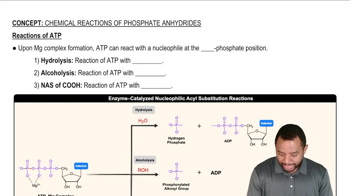
Chemical Reactions of Phosphate Anhydrides Concept 3

Role of H+ in Reactions

In organic chemistry, H+ ions can act as catalysts by protonating certain functional groups, making them more electrophilic and thus more reactive. However, in the case of aminolysis of esters, the presence of H+ does not enhance the reaction rate because it can also protonate the amine, reducing its nucleophilicity. This balance is essential to understand why H+ does not facilitate the reaction.
Video consigliato:
02:10
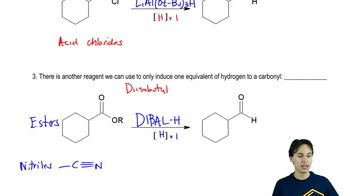
DIBAL-H on Esters and Nitriles

Equilibrium Considerations

The rate of a chemical reaction is often influenced by the position of equilibrium. In the case of aminolysis, if H+ is added, it can shift the equilibrium towards the protonated species, which are less reactive. This shift can hinder the formation of the desired products, illustrating that simply adding acid does not always increase the reaction rate and can sometimes have the opposite effect.
Video consigliato:
04:00
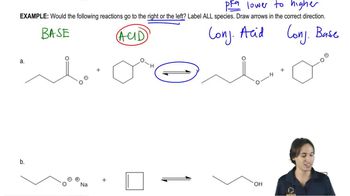
Determining Acid/Base Equilibrium