Ch. 15 - Reactions of Carboxylic Acids and Carboxylic Acid Derivatives
Bruice - Organic Chemistry 8th Edition
Bruice8th EditionOrganic ChemistryISBN: 9780135213711Non è quello che usi tu?Cambia libro di testo
Capitolo 15, Problema 33

What acyl chloride and amine are required to synthesize the following amides?
a. N-ethylbutanamide
b. N,N-dimethylbenzamide

Guida verificata passo dopo passo
1
Step 1: Understand the structure of the amide. Amides are formed through a reaction between an acyl chloride and an amine. The general reaction is: \( \text{RCOCl} + \text{R'NH}_2 \rightarrow \text{RCONHR'} \). For each amide, identify the acyl group (RCO-) and the amine group (R'NH2).
Step 2: For N-ethylbutanamide, break down the name. 'Butanamide' indicates the acyl group is derived from butanoic acid (\( \text{CH}_3\text{CH}_2\text{CH}_2\text{COCl} \)). 'N-ethyl' indicates the amine group is ethylamine (\( \text{CH}_3\text{CH}_2\text{NH}_2 \)).
Step 3: For N,N-dimethylbenzamide, break down the name. 'Benzamide' indicates the acyl group is derived from benzoic acid (\( \text{C}_6\text{H}_5\text{COCl} \)). 'N,N-dimethyl' indicates the amine group is dimethylamine (\( \text{(CH}_3\text{)}_2\text{NH} \)).
Step 4: Write the reaction for each synthesis. For N-ethylbutanamide: \( \text{CH}_3\text{CH}_2\text{CH}_2\text{COCl} + \text{CH}_3\text{CH}_2\text{NH}_2 \rightarrow \text{CH}_3\text{CH}_2\text{CH}_2\text{CONHCH}_2\text{CH}_3 \). For N,N-dimethylbenzamide: \( \text{C}_6\text{H}_5\text{COCl} + \text{(CH}_3\text{)}_2\text{NH} \rightarrow \text{C}_6\text{H}_5\text{CON(CH}_3\text{)}_2 \).
Step 5: Verify the structures of the products match the given amides. Ensure the acyl chloride and amine reactants correspond to the correct functional groups in the amide products.

Risposta video verificata per un problema simile:

Questa soluzione video è stata consigliata dai nostri tutor come utile per risolvere questo problema.
Durata del video:
3m

Concetti chiave

Ecco i concetti essenziali che devi comprendere per rispondere correttamente alla domanda.

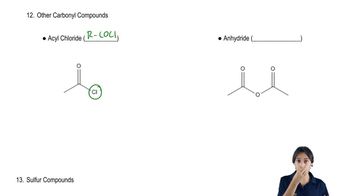
Acyl Chlorides

Acyl chlorides, also known as acid chlorides, are reactive organic compounds derived from carboxylic acids by replacing the hydroxyl group (-OH) with a chlorine atom. They are commonly used in organic synthesis due to their ability to react with nucleophiles, such as amines, to form amides. Understanding the structure and reactivity of acyl chlorides is essential for determining the appropriate acyl chloride needed for amide synthesis.
Video consigliato:
01:57
Recognizing acyl chlorides and anhydrides.

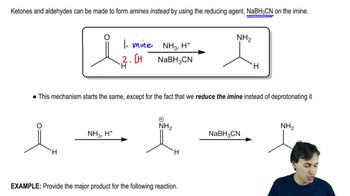
Amines

Amines are organic compounds that contain nitrogen atoms bonded to carbon atoms. They can be classified as primary, secondary, or tertiary based on the number of carbon groups attached to the nitrogen. In the context of amide synthesis, the type of amine used (e.g., primary or secondary) influences the structure of the resulting amide. Recognizing the differences between these amines is crucial for selecting the correct amine for the desired amide product.
Video consigliato:
07:12
Reductive Amination

Amide Formation

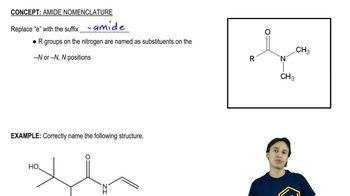
Amide formation is a chemical reaction where an acyl chloride reacts with an amine to produce an amide and hydrochloric acid as a byproduct. This reaction is a key transformation in organic chemistry, often utilized in the synthesis of pharmaceuticals and other compounds. Understanding the mechanism of this reaction, including the role of nucleophilicity and electrophilicity, is vital for predicting the products formed in the synthesis of specific amides.
Video consigliato:
01:33
Amide Nomenclature