Ch. 15 - Reactions of Carboxylic Acids and Carboxylic Acid Derivatives
Bruice - Organic Chemistry 8th Edition
Bruice8th EditionOrganic ChemistryISBN: 9780135213711Non è quello che usi tu?Cambia libro di testo
Capitolo 15, Problema 68d

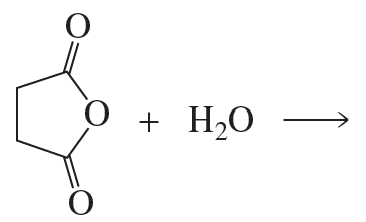
What are the products of the following reactions?
d. Chemical reaction showing a cyclic compound with two carbonyl groups reacting with water to form products.

Guida verificata passo dopo passo
1
Step 1: Identify the functional group in the reactant. The given compound is phthalic anhydride, which contains an anhydride functional group. Anhydrides are reactive towards water and undergo hydrolysis.
Step 2: Understand the reaction mechanism. When anhydrides react with water, they are hydrolyzed to form two carboxylic acids. The reaction involves the cleavage of the anhydride bond.
Step 3: Predict the products. Hydrolysis of phthalic anhydride will yield phthalic acid, which has two carboxylic acid groups attached to a benzene ring.
Step 4: Write the chemical equation for the reaction. The reaction can be represented as: PhthalicAnhydride+H2O→PhthalicAcid
Step 5: Note the structural change. The anhydride ring opens up, and two hydroxyl groups from water are added to form two carboxylic acid groups. This is a typical hydrolysis reaction for anhydrides.

Risposta video verificata per un problema simile:

Questa soluzione video è stata consigliata dai nostri tutor come utile per risolvere questo problema.
Durata del video:
2m

Concetti chiave

Ecco i concetti essenziali che devi comprendere per rispondere correttamente alla domanda.

Ester Hydrolysis

Ester hydrolysis is a chemical reaction where an ester reacts with water to form an alcohol and a carboxylic acid. This reaction can occur under acidic or basic conditions, but in this case, it is acid-catalyzed, which means an acid is used to speed up the reaction. The presence of the acid helps to protonate the carbonyl oxygen, making the carbon more electrophilic and facilitating the nucleophilic attack by water.
Video consigliato:
Percorso guidato
0:48
Hydrolysis of Phosphate Esters Concept 2

Acid-Catalyzed Reaction Mechanism

In acid-catalyzed reactions, the acid donates a proton (H+) to a reactant, enhancing its reactivity. For ester hydrolysis, the acid protonates the carbonyl oxygen of the ester, increasing the electrophilicity of the carbonyl carbon. This step is crucial as it allows water, acting as a nucleophile, to attack the carbonyl carbon, leading to the cleavage of the ester bond and the formation of the products.
Video consigliato:
06:34
Acid-catalyzed hydration mechanism

Products of Hydrolysis

The products of ester hydrolysis are typically a carboxylic acid and an alcohol. In the case of the given reaction, the ester structure shown will yield a specific carboxylic acid and an alcohol upon hydrolysis. Identifying the structure of the starting ester is essential to predict the exact products formed after the reaction with water.
Video consigliato:
Percorso guidato
1:00
Hydrolysis of Thioesters Concept 2