Ch. 15 - Reactions of Carboxylic Acids and Carboxylic Acid Derivatives
Bruice - Organic Chemistry 8th Edition
Bruice8th EditionOrganic ChemistryISBN: 9780135213711Non è quello che usi tu?Cambia libro di testo
Capitolo 15, Problema 17b

Write a mechanism for each of the following reactions:
b. the aminolysis of phenyl formate, using methylamine.

Guida verificata passo dopo passo
1
Identify the reactants and products: Phenyl formate (an ester) reacts with methylamine (a nucleophile) in an aminolysis reaction to form N-methylformamide and phenol. The reaction involves nucleophilic substitution at the ester carbonyl carbon.
Step 1: Nucleophilic attack - The lone pair of electrons on the nitrogen atom of methylamine attacks the carbonyl carbon of phenyl formate. This forms a tetrahedral intermediate. Represent this step as: R1-C(O)OR2+NHR3→R-C(O)NHR3+OH
Step 2: Proton transfer - The intermediate formed in Step 1 undergoes a proton transfer. The nitrogen atom in the intermediate donates a proton to the oxygen atom of the leaving group (phenoxide ion). This stabilizes the intermediate and prepares it for the next step.
Step 3: Collapse of the tetrahedral intermediate - The tetrahedral intermediate collapses, reforming the carbonyl group and expelling the phenoxide ion as the leaving group. This step completes the substitution reaction, forming N-methylformamide.
Step 4: Final product formation - The phenoxide ion (C6H5O-) abstracts a proton from the reaction medium (if available) to form phenol (C6H5OH). The final products of the reaction are N-methylformamide and phenol.

Risposta video verificata per un problema simile:

Questa soluzione video è stata consigliata dai nostri tutor come utile per risolvere questo problema.
Durata del video:
8m

Concetti chiave

Ecco i concetti essenziali che devi comprendere per rispondere correttamente alla domanda.

Aminolysis

Aminolysis is a chemical reaction where an amine reacts with a substrate, typically an ester or an amide, resulting in the substitution of the leaving group by the amine. In this process, the nucleophilic amine attacks the electrophilic carbon of the carbonyl group, leading to the formation of an amide or an amino alcohol, depending on the substrate. Understanding this mechanism is crucial for predicting the products and the reaction conditions.
Video consigliato:
Percorso guidato
3:20
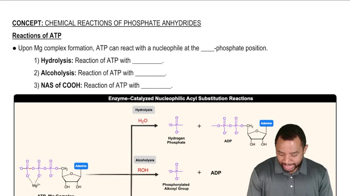
Chemical Reactions of Phosphate Anhydrides Concept 3

Phenyl Formate

Phenyl formate is an aromatic ester formed from phenol and formic acid. It contains a phenyl group attached to a formate moiety, making it a suitable substrate for aminolysis reactions. The presence of the carbonyl group in phenyl formate is essential, as it is the site of nucleophilic attack by the amine during the reaction, leading to the formation of a new bond.
Video consigliato:
Percorso guidato
1:45
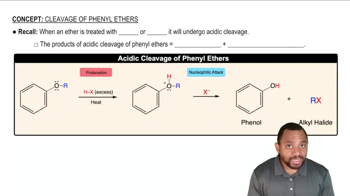
Cleavage of Phenyl Ethers Concept 1

Nucleophilic Attack

Nucleophilic attack is a fundamental concept in organic chemistry where a nucleophile, which is an electron-rich species, attacks an electrophile, an electron-deficient species. In the context of aminolysis, the nitrogen atom of the amine acts as the nucleophile, attacking the carbonyl carbon of phenyl formate. This step is critical for the reaction mechanism, as it initiates the transformation of the reactants into products.
Video consigliato:
08:27
Nucleophilic Addition