Starting with methyl acetate, what neutral nucleophile would you use to synthesize each of the following compounds? b. acetamide
Ch. 15 - Reactions of Carboxylic Acids and Carboxylic Acid Derivatives
Tutti i libri di testo
Bruice 8th Edition
Ch. 15 - Reactions of Carboxylic Acids and Carboxylic Acid Derivatives
Problema 13a
Bruice 8th Edition
Ch. 15 - Reactions of Carboxylic Acids and Carboxylic Acid Derivatives
Problema 13aCapitolo 15, Problema 13a
Write the mechanism for each of the following reactions:
a. the reaction of acetyl chloride with water to form acetic acid
Guida verificata passo dopo passo1
Identify the functional groups involved: Acetyl chloride (CH3COCl) is an acid chloride, and water (H2O) is a nucleophile. Acid chlorides are highly reactive due to the electron-withdrawing nature of the chlorine atom, making the carbonyl carbon highly electrophilic.
Step 1: Nucleophilic attack. The lone pair of electrons on the oxygen atom of water attacks the electrophilic carbonyl carbon of acetyl chloride. This forms a tetrahedral intermediate where the carbon is bonded to the original groups (CH3, Cl, and OH2+).
Step 2: Collapse of the tetrahedral intermediate. The negatively charged oxygen from the water attack donates its lone pair back to reform the carbonyl group, causing the chloride ion (Cl⁻) to leave as a leaving group. This step generates acetic acid (CH3COOH) and a chloride ion.
Step 3: Proton transfer. The intermediate acetic acid molecule may initially have an extra proton on the hydroxyl group (OH2+). A proton transfer occurs, either intramolecularly or with the help of another water molecule, to neutralize the charge and form the final acetic acid product.
Review the overall reaction: The reaction converts acetyl chloride (CH3COCl) and water (H2O) into acetic acid (CH3COOH) and hydrochloric acid (HCl). This is a nucleophilic acyl substitution reaction, where the chloride group is replaced by a hydroxyl group.

Risposta video verificata per un problema simile:
Questa soluzione video è stata consigliata dai nostri tutor come utile per risolvere questo problema.
Durata del video:
2mConcetti chiave
Ecco i concetti essenziali che devi comprendere per rispondere correttamente alla domanda.
Nucleophilic Acyl Substitution
Nucleophilic acyl substitution is a fundamental reaction mechanism in organic chemistry where a nucleophile attacks the carbonyl carbon of an acyl compound, leading to the substitution of the acyl group. In the case of acetyl chloride reacting with water, water acts as the nucleophile, attacking the carbonyl carbon of acetyl chloride, resulting in the formation of acetic acid and hydrochloric acid.
Video consigliato:
Nucleophiles and Electrophiles can react in Substitution Reactions.
Acyl Chlorides
Acyl chlorides, also known as acid chlorides, are reactive compounds derived from carboxylic acids by replacing the hydroxyl group with a chlorine atom. They are highly reactive due to the presence of the electronegative chlorine atom, which makes the carbonyl carbon more susceptible to nucleophilic attack. Understanding their reactivity is crucial for predicting the outcome of reactions involving acyl chlorides.
Video consigliato:
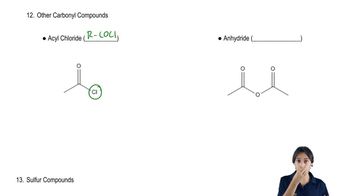
Recognizing acyl chlorides and anhydrides.
Hydrolysis Reactions
Hydrolysis reactions involve the reaction of a compound with water, leading to the breakdown of that compound. In organic chemistry, hydrolysis is often used to convert acyl chlorides into carboxylic acids. This reaction is typically exothermic and can be catalyzed by the presence of acids or bases, although in this case, water alone suffices to facilitate the conversion of acetyl chloride to acetic acid.
Video consigliato:
Percorso guidato
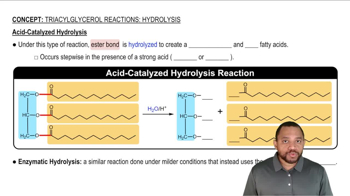
Triacylglycerol Reactions: Hydrolysis Concept 3
Pratica correlata
Domanda del libro di testo
853
views
Domanda del libro di testo
Write the mechanism for each of the following reactions:
b. the reaction of benzoyl chloride with excess methylamine to form N-methylbenzamide
1578
views
Domanda del libro di testo
Starting with methyl acetate, what neutral nucleophile would you use to synthesize each of the following compounds? a. ethyl acetate
1212
views
Domanda del libro di testo
Starting with acetyl chloride, what neutral nucleophile would you use to synthesize each of the following compounds?
e.
1147
views
Domanda del libro di testo
Starting with acetyl chloride, what neutral nucleophile would you use to synthesize each of the following compounds?
f.
1150
views
Domanda del libro di testo
Starting with acetyl chloride, what neutral nucleophile would you use to synthesize each of the following compounds?
d.
1050
views