Ch. 16 - Reactions of Aldehydes and Ketones • More Reactions of Carboxylic Acid Derivatives
Bruice - Organic Chemistry 8th Edition
Bruice8th EditionOrganic ChemistryISBN: 9780135213711Non è quello che usi tu?Cambia libro di testo
Capitolo 16, Problema 57a(7)

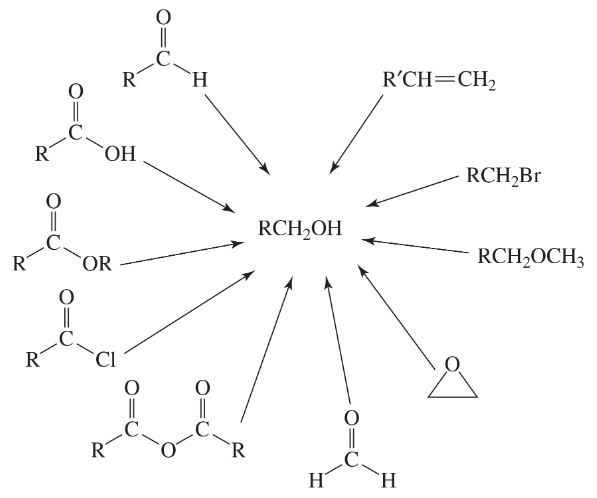
a. Show the reagents required to form the primary alcohol in each of the following reactions.


Guida verificata passo dopo passo
1
Step 1: Identify the starting material and the product. The starting material is an epoxide (a three-membered cyclic ether), and the product is a primary alcohol.
Step 2: Recognize the type of reaction. This is a ring-opening reaction of the epoxide to form a primary alcohol. The nucleophile attacks the less substituted carbon of the epoxide due to steric hindrance.
Step 3: Choose the appropriate nucleophile and acidic or basic conditions. To form a primary alcohol, water (H₂O) can act as the nucleophile, and an acid catalyst such as H⁺ (e.g., H₂SO₄) is typically used to protonate the epoxide and facilitate the ring opening.
Step 4: Describe the mechanism. The epoxide is protonated by the acid catalyst, making the oxygen more electrophilic. Water then attacks the less substituted carbon of the epoxide, leading to the formation of the primary alcohol.
Step 5: Summarize the reagents required. The reaction requires water (H₂O) as the nucleophile and an acid catalyst (e.g., H₂SO₄) to form the primary alcohol from the epoxide.

Risposta video verificata per un problema simile:

Questa soluzione video è stata consigliata dai nostri tutor come utile per risolvere questo problema.
Durata del video:
5m

Concetti chiave

Ecco i concetti essenziali che devi comprendere per rispondere correttamente alla domanda.

Epoxide Chemistry

Epoxides are three-membered cyclic ethers that are highly reactive due to the strain in their ring structure. They can undergo ring-opening reactions in the presence of nucleophiles, leading to the formation of various products, including alcohols. Understanding the mechanism of epoxide ring-opening is crucial for predicting the outcome of reactions involving these compounds.
Video consigliato:
02:19
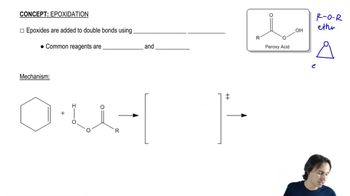
General properties of epoxidation.

Nucleophilic Attack

Nucleophilic attack is a fundamental concept in organic chemistry where a nucleophile, which is an electron-rich species, attacks an electron-deficient center, such as a carbon atom in an epoxide. This process often leads to the formation of new bonds and is essential for converting epoxides into alcohols. The regioselectivity of the attack can influence the final product's structure.
Video consigliato:
08:27
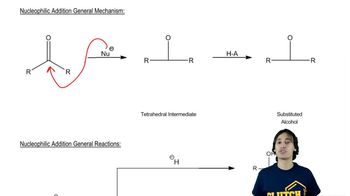
Nucleophilic Addition

Reagents for Alcohol Formation

To convert an epoxide into a primary alcohol, specific reagents are required. Typically, a nucleophile such as water or an alcohol is used in the presence of an acid catalyst to facilitate the ring-opening. The choice of nucleophile and conditions can determine whether the resulting alcohol is primary, secondary, or tertiary, making it important to select the appropriate reagents for the desired outcome.
Video consigliato:
01:52
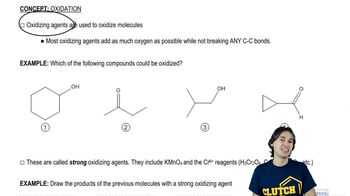
Reagents