
Ch. 16 - Reactions of Aldehydes and Ketones • More Reactions of Carboxylic Acid Derivatives
Bruice - Organic Chemistry 8th Edition
Bruice8th EditionOrganic ChemistryISBN: 9780135213711Non è quello che usi tu?Cambia libro di testo
Capitolo 16, Problema 88

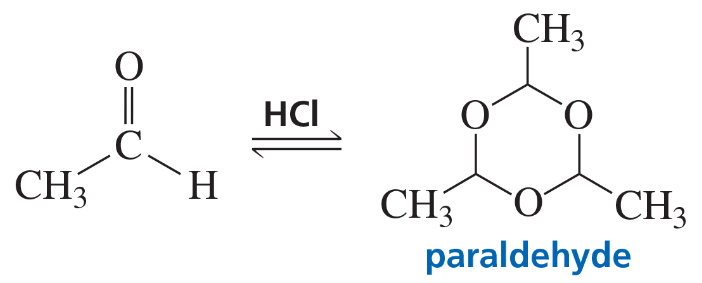
In the presence of an acid catalyst, acetaldehyde forms a trimer known as paraldehyde. Because it induces sleep when it is administered to animals in large doses, paraldehyde is used as a sedative or hypnotic. Propose a mechanism for the formation of paraldehyde.

Guida verificata passo dopo passo
1
Step 1: Protonation of acetaldehyde - In the presence of an acid catalyst such as HCl, the carbonyl oxygen of acetaldehyde (CH₃CHO) is protonated, increasing the electrophilicity of the carbonyl carbon. This step forms a resonance-stabilized carbocation intermediate.
Step 2: Nucleophilic attack - A second molecule of acetaldehyde acts as a nucleophile and attacks the carbocation intermediate formed in Step 1. This results in the formation of a dimer intermediate with a hydroxyl group and a new carbon-carbon bond.
Step 3: Protonation of the hydroxyl group - The hydroxyl group in the dimer intermediate is protonated by the acid catalyst, converting it into a better leaving group (water). This step prepares the molecule for further reaction.
Step 4: Formation of the trimer - A third molecule of acetaldehyde attacks the carbocation formed in Step 3, leading to the formation of a cyclic trimer structure. This step involves the creation of three carbon-oxygen bonds in the cyclic structure.
Step 5: Deprotonation and stabilization - The final step involves deprotonation of the cyclic trimer to yield paraldehyde, a stable cyclic trimer of acetaldehyde. This completes the mechanism.

Risposta video verificata per un problema simile:

Questa soluzione video è stata consigliata dai nostri tutor come utile per risolvere questo problema.
Durata del video:
2m

Concetti chiave

Ecco i concetti essenziali che devi comprendere per rispondere correttamente alla domanda.

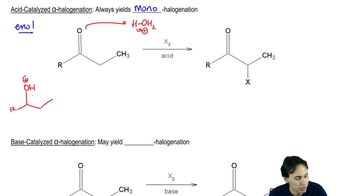
Acid-Catalyzed Reactions

Acid-catalyzed reactions involve the use of an acid to increase the rate of a chemical reaction. In organic chemistry, acids can protonate reactants, making them more electrophilic and facilitating nucleophilic attacks. Understanding this concept is crucial for analyzing how acetaldehyde reacts under acidic conditions to form paraldehyde.
Video consigliato:
03:09
Acid Catalyzed

Aldol Condensation

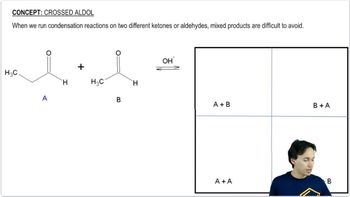
Aldol condensation is a reaction where aldehydes or ketones react in the presence of a base or acid to form β-hydroxy aldehydes or ketones, which can further dehydrate to yield α,β-unsaturated carbonyl compounds. This mechanism is essential for understanding how acetaldehyde can undergo self-condensation to form paraldehyde through a series of aldol reactions.
Video consigliato:
09:51
Crossed Aldol

Trimerization

Trimerization is a chemical process where three molecules of a reactant combine to form a single product. In the case of acetaldehyde, trimerization leads to the formation of paraldehyde. Recognizing the significance of this process helps in visualizing how multiple acetaldehyde units can interact to create a larger, cyclic compound.
Video consigliato:
Percorso guidato
1:13
Quaternary Protein Structure Example 1