Ch. 16 - Reactions of Aldehydes and Ketones • More Reactions of Carboxylic Acid Derivatives
Bruice - Organic Chemistry 8th Edition
Bruice8th EditionOrganic ChemistryISBN: 9780135213711Non è quello che usi tu?Cambia libro di testo
Capitolo 16, Problema 74a

List three different sets of reagents (each set consisting of a carbonyl compound and a Grignard reagent) that could be used to prepare each of the following tertiary alcohols:
a.

Guida verificata passo dopo passo
1
Step 1: Analyze the structure of the tertiary alcohol provided. The alcohol group (-OH) is attached to a carbon atom that is bonded to three other groups: a phenyl group (benzene ring), an ethyl group (CH3CH2-), and a butyl group (CH3CH2CH2CH2-). This indicates that the alcohol is tertiary.
Step 2: Recall the general mechanism for forming tertiary alcohols using Grignard reagents. A Grignard reagent (R-MgX) reacts with a carbonyl compound (aldehyde or ketone) to form an alcohol. For tertiary alcohols, the carbonyl compound must be a ketone, and the Grignard reagent provides the third alkyl group.
Step 3: Identify possible combinations of ketones and Grignard reagents that could lead to the given tertiary alcohol. For example, one approach is to use acetophenone (C6H5COCH3) as the ketone and a Grignard reagent such as butyl magnesium bromide (CH3CH2CH2CH2MgBr). This reaction would add the butyl group to the carbonyl carbon, forming the desired alcohol.
Step 4: Consider alternative combinations. Another possibility is to use butanone (CH3CH2COCH3) as the ketone and phenyl magnesium bromide (C6H5MgBr) as the Grignard reagent. This reaction would add the phenyl group to the carbonyl carbon, forming the desired alcohol.
Step 5: Explore a third combination. You could use ethyl phenyl ketone (C6H5COCH2CH3) as the ketone and butyl magnesium bromide (CH3CH2CH2CH2MgBr) as the Grignard reagent. This reaction would add the butyl group to the carbonyl carbon, forming the desired alcohol.

Risposta video verificata per un problema simile:

Questa soluzione video è stata consigliata dai nostri tutor come utile per risolvere questo problema.
Durata del video:
5m

Concetti chiave

Ecco i concetti essenziali che devi comprendere per rispondere correttamente alla domanda.

Carbonyl Compounds

Carbonyl compounds are organic molecules characterized by the presence of a carbonyl group (C=O). They include aldehydes and ketones, which are crucial in organic synthesis. In the context of preparing tertiary alcohols, carbonyl compounds serve as electrophiles that react with nucleophiles, such as Grignard reagents, to form alcohols.
Video consigliato:
01:40
Defining meso compounds.

Grignard Reagents

Grignard reagents are organomagnesium compounds represented as RMgX, where R is an organic group and X is a halogen. They act as strong nucleophiles and are used to add carbon chains to carbonyl compounds. When a Grignard reagent reacts with a carbonyl compound, it forms an alkoxide intermediate, which can be protonated to yield an alcohol.
Video consigliato:
02:12
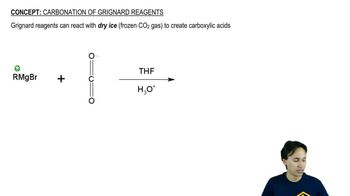
Carbonation of Grignard Reagents

Tertiary Alcohols

Tertiary alcohols are alcohols where the hydroxyl (-OH) group is attached to a carbon atom that is connected to three other carbon atoms. This structure makes them more sterically hindered and less reactive than primary or secondary alcohols. In synthesis, tertiary alcohols can be formed through the reaction of carbonyl compounds with Grignard reagents, which adds a carbon chain to the carbonyl carbon.
Video consigliato:
Percorso guidato
2:07
Tertiary Protein Structure Concept 1