Ch. 16 - Reactions of Aldehydes and Ketones • More Reactions of Carboxylic Acid Derivatives
Bruice - Organic Chemistry 8th Edition
Bruice8th EditionOrganic ChemistryISBN: 9780135213711Non è quello che usi tu?Cambia libro di testo
Capitolo 16, Problema 55

Rank the following compounds from most reactive to least reactive toward nucleophilic addition:
Five chemical structures are shown, illustrating compounds for ranking by reactivity toward nucleophilic addition.

Guida verificata passo dopo passo
1
Identify the functional groups present in each compound. Nucleophilic addition reactions typically occur at carbonyl groups (C=O), so focus on compounds containing aldehydes, ketones, esters, or other carbonyl-containing groups.
Consider the electronic effects of substituents attached to the carbonyl carbon. Electron-withdrawing groups (e.g., halogens, nitro groups) increase the electrophilicity of the carbonyl carbon, making it more reactive toward nucleophiles. Electron-donating groups (e.g., alkyl groups) decrease electrophilicity, reducing reactivity.
Evaluate steric hindrance around the carbonyl carbon. Compounds with less steric hindrance (e.g., aldehydes) are generally more reactive than those with more steric hindrance (e.g., ketones or bulky esters).
Rank the compounds based on their reactivity toward nucleophilic addition, considering both electronic and steric factors. Typically, the order of reactivity is: aldehydes > ketones > esters > amides, but this can vary depending on specific substituents.
Verify your ranking by considering resonance effects or other stabilizing interactions that might influence the reactivity of the carbonyl group in each compound.

Risposta video verificata per un problema simile:

Questa soluzione video è stata consigliata dai nostri tutor come utile per risolvere questo problema.
Durata del video:
2m

Concetti chiave

Ecco i concetti essenziali che devi comprendere per rispondere correttamente alla domanda.

Nucleophilic Addition

Nucleophilic addition is a fundamental reaction in organic chemistry where a nucleophile attacks an electrophilic center, typically a carbon atom in a carbonyl group. This reaction is crucial for forming new carbon-carbon or carbon-heteroatom bonds. The reactivity of compounds toward nucleophilic addition depends on the electrophilicity of the carbonyl carbon, which is influenced by factors such as steric hindrance and electronic effects.
Video consigliato:
08:27
Nucleophilic Addition

Electrophilicity

Electrophilicity refers to the tendency of a chemical species to accept electrons, making it a target for nucleophiles. In the context of carbonyl compounds, the more positive the carbonyl carbon is, the more reactive it is toward nucleophilic attack. Factors that enhance electrophilicity include the presence of electron-withdrawing groups and the overall stability of the molecule, which can affect the carbonyl's susceptibility to nucleophiles.
Video consigliato:
03:
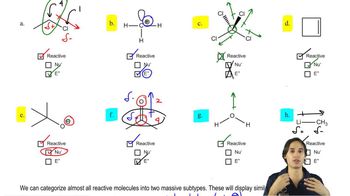
Nucleophile or Electrophile

Steric Hindrance

Steric hindrance is the prevention of chemical reactions due to the spatial arrangement of atoms within a molecule. In nucleophilic addition reactions, bulky substituents around the electrophilic center can impede the approach of nucleophiles, thereby decreasing reactivity. Understanding steric effects is essential for predicting the reactivity of various carbonyl compounds, as more sterically hindered compounds are generally less reactive toward nucleophilic addition.
Video consigliato:
02:53
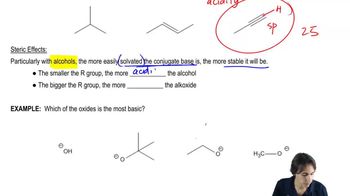
Understanding steric effects.