Ch. 16 - Reactions of Aldehydes and Ketones • More Reactions of Carboxylic Acid Derivatives
Bruice - Organic Chemistry 8th Edition
Bruice8th EditionOrganic ChemistryISBN: 9780135213711Non è quello che usi tu?Cambia libro di testo
Capitolo 16, Problema 60a,b

Using cyclohexanone as the starting material, describe how each of the following compounds can be synthesized:
a.
b.

Guida verificata passo dopo passo
1
Step 1: Analyze the target compounds. The first compound is cyclohexanol, which is an alcohol derived from cyclohexanone. The second compound is cyclohexene, which is an alkene derived from cyclohexanone.
Step 2: For the synthesis of cyclohexanol (compound a), perform a reduction reaction. Cyclohexanone can be reduced to cyclohexanol using a reducing agent such as sodium borohydride (NaBH₄) or lithium aluminum hydride (LiAlH₄). The reaction involves the addition of hydrogen to the carbonyl group of cyclohexanone.
Step 3: Write the chemical equation for the reduction of cyclohexanone to cyclohexanol: C₆H₁₀O+H₂→C₆H₁₂O
Step 4: For the synthesis of cyclohexene (compound b), perform a dehydration reaction. Cyclohexanol can be dehydrated to cyclohexene using an acid catalyst such as concentrated sulfuric acid (H₂SO₄) or phosphoric acid (H₃PO₄). The reaction involves the elimination of water from cyclohexanol.
Step 5: Write the chemical equation for the dehydration of cyclohexanol to cyclohexene: C₆H₁₂O→C₆H₁₀+H₂O

Risposta video verificata per un problema simile:

Questa soluzione video è stata consigliata dai nostri tutor come utile per risolvere questo problema.
Durata del video:
3m

Concetti chiave

Ecco i concetti essenziali che devi comprendere per rispondere correttamente alla domanda.

Cyclohexanone Structure and Reactivity

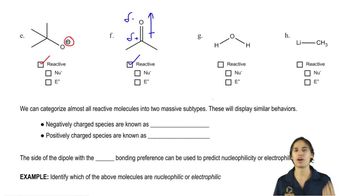
Cyclohexanone is a six-membered cyclic ketone with a carbonyl group (C=O) that significantly influences its reactivity. The carbonyl carbon is electrophilic, making it susceptible to nucleophilic attack, which is essential for various synthetic transformations. Understanding its structure helps in predicting the types of reactions it can undergo, such as nucleophilic addition or oxidation.
Video consigliato:
01:17
Reactivity of Molecules

Synthetic Pathways in Organic Chemistry

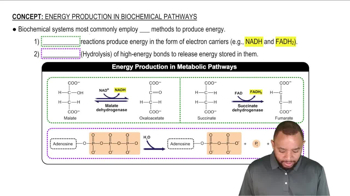
Synthetic pathways refer to the series of chemical reactions that transform a starting material into a desired product. In organic chemistry, these pathways often involve functional group transformations, rearrangements, and the use of reagents to achieve specific modifications. Familiarity with common synthetic strategies, such as reduction, oxidation, and substitution, is crucial for designing the synthesis of complex molecules from simpler precursors.
Video consigliato:
Percorso guidato
2:13
Energy Production In Biochemical Pathways Concept 1

Reagents and Reaction Conditions

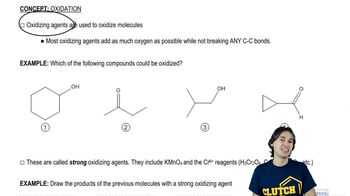
The choice of reagents and reaction conditions is critical in organic synthesis, as they determine the efficiency and selectivity of the reactions. Different reagents can facilitate specific transformations, such as Grignard reagents for nucleophilic additions or oxidizing agents for functional group conversions. Understanding how to select appropriate reagents and optimize conditions, such as temperature and solvent, is essential for successful synthesis.
Video consigliato:
01:52
Reagents