Ch. 16 - Reactions of Aldehydes and Ketones • More Reactions of Carboxylic Acid Derivatives
Bruice - Organic Chemistry 8th Edition
Bruice8th EditionOrganic ChemistryISBN: 9780135213711Non è quello che usi tu?Cambia libro di testo
Capitolo 16, Problema 66j

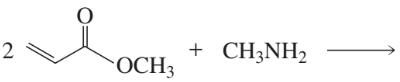
What are the products of the following reactions?
j. Chemical reaction diagram showing reactants and products for conjugate addition, including structures and arrows indicating reaction direction.

Guida verificata passo dopo passo
1
Step 1: Identify the reactants. Ethyl acrylate is an ester with an α,β-unsaturated carbonyl group, and ethanamine is a primary amine. This reaction involves nucleophilic addition or substitution.
Step 2: Recognize the reactivity of the α,β-unsaturated carbonyl group in ethyl acrylate. The double bond adjacent to the carbonyl group is electrophilic due to resonance stabilization, making it susceptible to nucleophilic attack.
Step 3: Ethanamine, as a nucleophile, will attack the electrophilic β-carbon of the α,β-unsaturated system in ethyl acrylate. This is a typical Michael addition reaction mechanism.
Step 4: After the nucleophilic attack, the intermediate formed undergoes proton transfer to stabilize the molecule. This results in the formation of a new bond between the amine and the β-carbon of ethyl acrylate.
Step 5: The final product is a β-amino ester, where the ethyl acrylate has been modified by the addition of ethanamine at the β-carbon position.

Risposta video verificata per un problema simile:

Questa soluzione video è stata consigliata dai nostri tutor come utile per risolvere questo problema.
Durata del video:
5m

Concetti chiave

Ecco i concetti essenziali che devi comprendere per rispondere correttamente alla domanda.

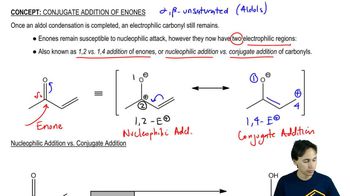
Conjugate Addition

Conjugate addition refers to the reaction where a nucleophile adds to the β-carbon of an α,β-unsaturated carbonyl compound. This process typically involves the attack of a nucleophile, such as an amine, on the double bond adjacent to the carbonyl group, leading to the formation of a new bond and a product that retains the carbonyl functionality.
Video consigliato:
09:23
1,2 vs 1,4 Addition

Reactivity of α,β-Unsaturated Carbonyl Compounds

α,β-Unsaturated carbonyl compounds, like ethyl acrylate, are highly reactive due to the presence of both a double bond and a carbonyl group. The electron-withdrawing nature of the carbonyl enhances the electrophilicity of the β-carbon, making it susceptible to nucleophilic attack, which is a key feature in many organic reactions, including conjugate additions.
Video consigliato:
01:15
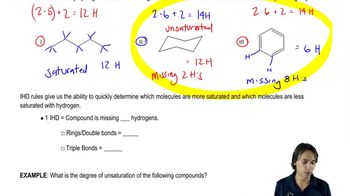
What index of hydrogen deficiency is.

Nucleophiles in Organic Reactions

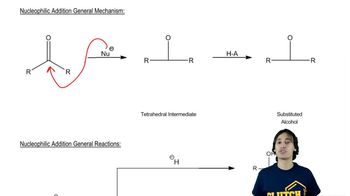
Nucleophiles are species that donate an electron pair to form a chemical bond in a reaction. In this context, ethanamine acts as a nucleophile, attacking the electrophilic β-carbon of ethyl acrylate. Understanding the nature of nucleophiles and their reactivity is crucial for predicting the products of organic reactions, particularly in conjugate addition scenarios.
Video consigliato:
08:27
Nucleophilic Addition