Ch. 16 - Reactions of Aldehydes and Ketones • More Reactions of Carboxylic Acid Derivatives
Bruice - Organic Chemistry 8th Edition
Bruice8th EditionOrganic ChemistryISBN: 9780135213711Non è quello che usi tu?Cambia libro di testo
Capitolo 16, Problema 9

Which of the following secondary alcohols can be prepared by the reaction of methyl formate with excess Grignard reagent?
Structural formulas of four secondary alcohols labeled A, B, C, and D, with hydroxyl groups indicated.

Guida verificata passo dopo passo
1
Step 1: Understand the reaction mechanism. Methyl formate (HCOOCH3) reacts with a Grignard reagent (R-MgX) in excess to form a secondary alcohol. The Grignard reagent adds to the carbonyl group of the ester, and after hydrolysis, a secondary alcohol is obtained.
Step 2: Analyze the structure of methyl formate. The carbonyl group (C=O) in methyl formate is the reactive site where the Grignard reagent will attack. The first equivalent of the Grignard reagent will replace the -OCH3 group, forming an intermediate ketone.
Step 3: Consider the role of excess Grignard reagent. The second equivalent of the Grignard reagent will attack the ketone intermediate, forming a tertiary alkoxide ion. Upon hydrolysis, this alkoxide ion is converted into a secondary alcohol.
Step 4: Match the product structure. The secondary alcohol formed will have the R group from the Grignard reagent attached to the carbon that was originally part of the carbonyl group in methyl formate. Analyze the options to determine which secondary alcohol matches this structure.
Step 5: Verify the correct answer. For each option, consider the structure of the secondary alcohol and determine if it can be formed by the reaction of methyl formate with a specific Grignard reagent. The correct answer will correspond to the alcohol that matches the described reaction mechanism.

Risposta video verificata per un problema simile:

Questa soluzione video è stata consigliata dai nostri tutor come utile per risolvere questo problema.
Durata del video:
11m

Concetti chiave

Ecco i concetti essenziali che devi comprendere per rispondere correttamente alla domanda.

Grignard Reagents

Grignard reagents are organomagnesium compounds that react with electrophiles to form carbon-carbon bonds. They are highly reactive and can add to carbonyl compounds, such as aldehydes and ketones, to form alcohols. Understanding their reactivity is crucial for predicting the products of reactions involving secondary alcohols.
Video consigliato:
02:12
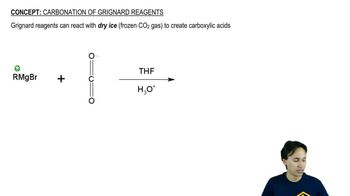
Carbonation of Grignard Reagents

Methyl Formate

Methyl formate is an ester that can act as a carbonyl compound in reactions with Grignard reagents. When a Grignard reagent reacts with methyl formate, it first forms a magnesium alkoxide intermediate, which can then be hydrolyzed to yield a secondary alcohol. Recognizing the structure and reactivity of methyl formate is essential for determining the possible alcohol products.
Video consigliato:
02:26
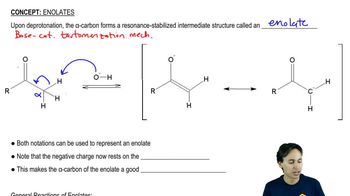
Formation of Enolates

Secondary Alcohols

Secondary alcohols are characterized by having the hydroxyl (-OH) group attached to a carbon atom that is connected to two other carbon atoms. The formation of secondary alcohols from the reaction of Grignard reagents with carbonyl compounds is a key concept in organic synthesis. Identifying which products are secondary alcohols helps in selecting the correct answer from the options provided.
Video consigliato:
Percorso guidato
1:24
Secondary Protein Structure Example 2