Ch. 17 - Reactions at the Alpha-Carbon
Bruice - Organic Chemistry 8th Edition
Bruice8th EditionOrganic ChemistryISBN: 9780135213711Non è quello che usi tu?Cambia libro di testo
Capitolo 17, Problema 32

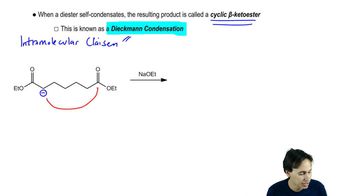
Write the mechanism for the reaction of a 1,7-diester with an alkoxide ion to form a cyclic b-keto ester.

Guida verificata passo dopo passo
1
Identify the starting material: The 1,7-diester contains two ester groups separated by six carbon atoms. This structure allows for the formation of a six-membered ring during the reaction.
Recognize the role of the alkoxide ion: The alkoxide ion acts as a base, abstracting a proton from the α-carbon (the carbon adjacent to one of the ester groups) to generate an enolate ion. This enolate is stabilized by resonance between the α-carbon and the carbonyl group.
Illustrate the nucleophilic attack: The enolate ion, acting as a nucleophile, attacks the carbonyl carbon of the second ester group within the same molecule. This intramolecular reaction forms a new carbon-carbon bond, initiating the formation of a six-membered ring.
Depict the tetrahedral intermediate: The nucleophilic attack results in a tetrahedral intermediate at the carbonyl carbon of the second ester group. This intermediate is unstable and will collapse, leading to the elimination of the alkoxide group (from the second ester).
Show the final product: The elimination of the alkoxide group results in the formation of a cyclic β-keto ester. The six-membered ring structure is stabilized by the conjugation between the ketone and ester groups.

Risposta video verificata per un problema simile:

Questa soluzione video è stata consigliata dai nostri tutor come utile per risolvere questo problema.
Durata del video:
6m

Concetti chiave

Ecco i concetti essenziali che devi comprendere per rispondere correttamente alla domanda.

Diester Reactivity

Diesters are compounds containing two ester functional groups. In the context of organic reactions, they can undergo nucleophilic attack due to the electrophilic nature of the carbonyl carbon. Understanding the reactivity of diesters is crucial for predicting how they will interact with nucleophiles, such as alkoxide ions, in a reaction mechanism.
Video consigliato:
03:27
Diesters (Dieckmann Condensation)

Nucleophilic Substitution Mechanism

Nucleophilic substitution is a fundamental reaction mechanism in organic chemistry where a nucleophile attacks an electrophile, resulting in the replacement of a leaving group. In this case, the alkoxide ion acts as the nucleophile, attacking the carbonyl carbon of the diester, leading to the formation of a cyclic structure. Familiarity with this mechanism is essential for understanding how cyclic b-keto esters are formed.
Video consigliato:
01:47
Nucleophiles and Electrophiles can react in Substitution Reactions.

Cyclic b-Keto Esters

Cyclic b-keto esters are cyclic compounds that contain both a ketone and an ester functional group. Their formation often involves intramolecular reactions, where a nucleophile attacks a carbonyl within the same molecule. Recognizing the structure and properties of cyclic b-keto esters is important for predicting their stability and reactivity in further chemical transformations.
Video consigliato:
02:39
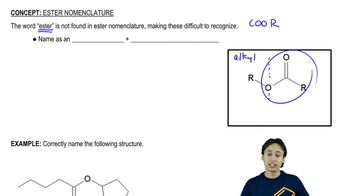
Ester Nomenclature