Ch. 18 - Reactions of Benzene and Substituted Benzenes
Bruice - Organic Chemistry 8th Edition
Bruice8th EditionOrganic ChemistryISBN: 9780135213711Non è quello che usi tu?Cambia libro di testo
Capitolo 18, Problema 39a

Rank the following compounds from greatest tendency to least tendency to undergo nucleophilic aromatic substitution:
chlorobenzene 
1-chloro-2,4-dinitrobenzene 
p-chloronitrobenzene

Guida verificata passo dopo passo
1
Identify the key factors that influence the tendency of a compound to undergo nucleophilic aromatic substitution (NAS). These include the presence of electron-withdrawing groups (EWGs) on the aromatic ring, their positions relative to the leaving group (chlorine in this case), and the stability of the intermediate Meisenheimer complex formed during the reaction.
Analyze chlorobenzene. Chlorobenzene lacks any electron-withdrawing groups on the aromatic ring. This means it has a very low tendency to undergo nucleophilic aromatic substitution because the intermediate Meisenheimer complex would not be stabilized.
Examine 1-chloro-2,4-dinitrobenzene. This compound has two strong electron-withdrawing nitro groups (-NO₂) at the ortho and para positions relative to the chlorine atom. These groups strongly stabilize the negative charge on the intermediate Meisenheimer complex, making this compound highly reactive in nucleophilic aromatic substitution.
Evaluate p-chloronitrobenzene. This compound has one nitro group (-NO₂) at the para position relative to the chlorine atom. While it is less reactive than 1-chloro-2,4-dinitrobenzene due to having only one EWG, the nitro group still stabilizes the intermediate Meisenheimer complex, making it more reactive than chlorobenzene.
Rank the compounds based on their tendency to undergo nucleophilic aromatic substitution: 1-chloro-2,4-dinitrobenzene (greatest tendency) > p-chloronitrobenzene > chlorobenzene (least tendency).

Risposta video verificata per un problema simile:

Questa soluzione video è stata consigliata dai nostri tutor come utile per risolvere questo problema.
Durata del video:
2m

Concetti chiave

Ecco i concetti essenziali che devi comprendere per rispondere correttamente alla domanda.

Nucleophilic Aromatic Substitution (NAS)

Nucleophilic aromatic substitution is a reaction where a nucleophile replaces a leaving group on an aromatic ring. This process is facilitated by the presence of electron-withdrawing groups, which stabilize the negative charge on the intermediate Meisenheimer complex. Understanding the mechanism and conditions that favor NAS is crucial for predicting the reactivity of aromatic compounds.
Video consigliato:
02:10
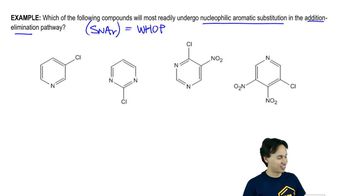
NAS in the addition-elimination pathway

Electron-Withdrawing Groups (EWGs)

Electron-withdrawing groups are substituents that pull electron density away from the aromatic ring, enhancing its susceptibility to nucleophilic attack. Common EWGs include nitro (-NO2) and cyano (-CN) groups. The presence and position of these groups significantly influence the reactivity of the aromatic compound in nucleophilic aromatic substitution reactions.
Video consigliato:
02:37
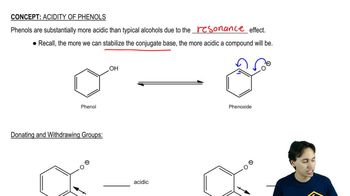
Donating vs Withdrawing Groups

Resonance and Stability

Resonance refers to the delocalization of electrons within a molecule, which can stabilize charged intermediates. In the context of nucleophilic aromatic substitution, compounds with strong resonance stabilization of the negative charge in the intermediate are more likely to undergo substitution. The stability of the intermediate formed during the reaction is a key factor in determining the tendency of the compound to react.
Video consigliato:
03:43
The radical stability trend.