Ch. 18 - Reactions of Benzene and Substituted Benzenes
Bruice - Organic Chemistry 8th Edition
Bruice8th EditionOrganic ChemistryISBN: 9780135213711Non è quello che usi tu?Cambia libro di testo
Capitolo 18, Problema 18d,e,f

Are the following substituents ortho–para directors or meta directors?
d. COOH
e. CF3
f. N=O

Guida verificata passo dopo passo
1
Step 1: Understand the concept of substituent effects in electrophilic aromatic substitution reactions. Substituents on a benzene ring can influence the position of incoming groups by either donating or withdrawing electron density. Electron-donating groups are typically ortho–para directors, while electron-withdrawing groups are meta directors.
Step 2: Analyze the functional group COOH (carboxylic acid). The COOH group contains a carbonyl group (C=O) and an -OH group. The carbonyl group is highly electron-withdrawing due to resonance and inductive effects, pulling electron density away from the benzene ring. This makes COOH a meta director.
Step 3: Examine the functional group CF3 (trifluoromethyl). The CF3 group is strongly electron-withdrawing due to the high electronegativity of fluorine atoms, which exert a strong inductive effect. This electron withdrawal reduces electron density on the benzene ring, making CF3 a meta director.
Step 4: Evaluate the functional group N=O (nitroso group). The nitroso group is electron-withdrawing due to resonance and inductive effects, as the nitrogen atom can pull electron density away from the benzene ring through its double bond to oxygen. This makes N=O a meta director.
Step 5: Summarize the findings: COOH, CF3, and N=O are all electron-withdrawing groups, and therefore, they direct incoming substituents to the meta position in electrophilic aromatic substitution reactions.

Risposta video verificata per un problema simile:

Questa soluzione video è stata consigliata dai nostri tutor come utile per risolvere questo problema.
Durata del video:
8m

Concetti chiave

Ecco i concetti essenziali che devi comprendere per rispondere correttamente alla domanda.

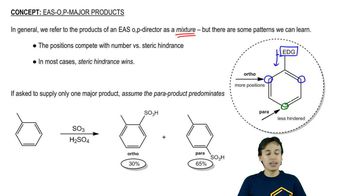
Ortho-Para vs. Meta Directors

In electrophilic aromatic substitution, substituents on a benzene ring can influence the position where new substituents are added. Ortho-para directors promote substitution at the ortho and para positions relative to themselves, while meta directors favor substitution at the meta position. Understanding these classifications is crucial for predicting the outcomes of reactions involving aromatic compounds.
Video consigliato:
04:42
Ortho, Para major products

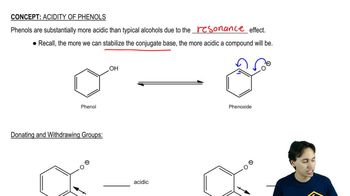
Electron-Withdrawing vs. Electron-Donating Groups

Substituents can be classified as electron-withdrawing groups (EWGs) or electron-donating groups (EDGs) based on their effect on the electron density of the aromatic ring. EWGs, such as -COOH and -CF3, typically deactivate the ring and direct substitution to the meta position. In contrast, EDGs increase electron density and direct substitution to the ortho and para positions.
Video consigliato:
02:37
Donating vs Withdrawing Groups

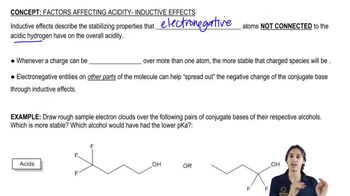
Resonance and Inductive Effects

The behavior of substituents in directing electrophilic substitution can be explained through resonance and inductive effects. Resonance involves the delocalization of electrons, which can stabilize or destabilize intermediates during reactions. Inductive effects arise from the electronegativity of atoms in a substituent, influencing the electron density of the aromatic ring and thus its reactivity and substitution pattern.
Video consigliato:
01:47
Understanding the Inductive Effect.