Ch. 2 - Acids and Bases: Central to Understanding Organic Chemistry
Bruice - Organic Chemistry 8th Edition
Bruice8th EditionOrganic ChemistryISBN: 9780135213711Non è quello che usi tu?Cambia libro di testo
Capitolo 2, Problema 4a

What is the conjugate acid of each of the following?
1. NH3
2. Cl−
3. HO−
4. H2O

Guida verificata passo dopo passo
1
Step 1: Understand the concept of a conjugate acid. A conjugate acid is formed when a base gains a proton (H⁺). This involves identifying the base and adding an H⁺ to it.
Step 2: For NH₃ (ammonia), add an H⁺ to the molecule. This results in NH₄⁺ (ammonium ion). Write the chemical equation: NH₃ + H⁺ → NH₄⁺.
Step 3: For Cl⁻ (chloride ion), add an H⁺ to the ion. This results in HCl (hydrogen chloride). Write the chemical equation: Cl⁻ + H⁺ → HCl.
Step 4: For HO⁻ (hydroxide ion), add an H⁺ to the ion. This results in H₂O (water). Write the chemical equation: HO⁻ + H⁺ → H₂O.
Step 5: For H₂O (water), add an H⁺ to the molecule. This results in H₃O⁺ (hydronium ion). Write the chemical equation: H₂O + H⁺ → H₃O⁺.

Risposta video verificata per un problema simile:

Questa soluzione video è stata consigliata dai nostri tutor come utile per risolvere questo problema.
Durata del video:
3m

Concetti chiave

Ecco i concetti essenziali che devi comprendere per rispondere correttamente alla domanda.

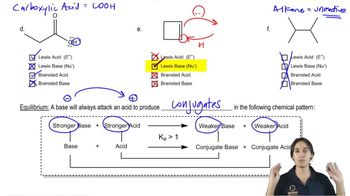
Conjugate Acid-Base Theory

In acid-base chemistry, a conjugate acid is formed when a base accepts a proton (H+). This theory, primarily based on the Brønsted-Lowry definition, emphasizes the transfer of protons between species. Understanding this concept is crucial for identifying the conjugate acids of various bases, as it allows for the prediction of their behavior in chemical reactions.
Video consigliato:
02:11
Equilibrium constant and conjugates.

Ammonia (NH3) as a Base

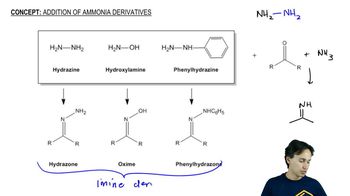
Ammonia (NH3) is a common weak base that can accept a proton to form its conjugate acid, ammonium (NH4+). This reaction illustrates the basic nature of ammonia, which is often involved in acid-base reactions. Recognizing ammonia's role as a base is essential for determining its conjugate acid.
Video consigliato:
02:49
Ammonia Derivatives

Water (H2O) as an Amphoteric Substance

Water (H2O) is an amphoteric substance, meaning it can act as both an acid and a base. When it acts as a base, it can accept a proton to form the hydronium ion (H3O+), which is its conjugate acid. This dual behavior is important for understanding the conjugate acids of other species, such as hydroxide (HO−) and chloride (Cl−), in aqueous solutions.
Video consigliato:
Percorso guidato
1:35
Metal Ion Catalysis: Water Activation Concept 1