Ch. 2 - Acids and Bases: Central to Understanding Organic Chemistry
Bruice - Organic Chemistry 8th Edition
Bruice8th EditionOrganic ChemistryISBN: 9780135213711Non è quello che usi tu?Cambia libro di testo
Capitolo 2, Problema 39g,h

For each of the following compounds (here shown in their acidic forms), write the form that ­predominates in a solution with a pH = 5.5:
g. HNO2 (pKa = 3.4)
h. HNO3 (pKa = −1.3)

Guida verificata passo dopo passo
1
Step 1: Understand the problem. The question asks us to determine the predominant form of the given compounds in a solution with a pH of 5.5. To do this, we need to compare the pH of the solution to the pKa of each compound. The relationship between pH and pKa is described by the Henderson-Hasselbalch equation: pH=pKa+log([A-][HA]), where [A⁻] is the concentration of the conjugate base and [HA] is the concentration of the acid.
Step 2: Analyze the first compound, HNO2 (pKa = 3.4). Compare the pH of the solution (5.5) to the pKa of HNO2. Since the pH is greater than the pKa, the solution is more basic relative to the acid's dissociation constant. This means the conjugate base (NO2⁻) will predominate over the acidic form (HNO2).
Step 3: Analyze the second compound, HNO3 (pKa = -1.3). Compare the pH of the solution (5.5) to the pKa of HNO3. The pH is significantly higher than the pKa, indicating that the solution is much more basic relative to the acid's dissociation constant. As a result, the conjugate base (NO3⁻) will predominate over the acidic form (HNO3).
Step 4: Summarize the findings. For HNO2, the predominant form at pH 5.5 is NO2⁻. For HNO3, the predominant form at pH 5.5 is NO3⁻. This conclusion is based on the comparison of pH and pKa values and the application of the Henderson-Hasselbalch equation.
Step 5: Note the general principle. When the pH of a solution is higher than the pKa of an acid, the conjugate base form predominates. Conversely, when the pH is lower than the pKa, the acidic form predominates. This principle can be applied to similar problems in acid-base chemistry.

Risposta video verificata per un problema simile:

Questa soluzione video è stata consigliata dai nostri tutor come utile per risolvere questo problema.
Durata del video:
3m

Concetti chiave

Ecco i concetti essenziali che devi comprendere per rispondere correttamente alla domanda.

pKa and Acid-Base Equilibrium

pKa is a measure of the strength of an acid in solution, indicating the pH at which half of the acid is dissociated. A lower pKa value signifies a stronger acid, meaning it dissociates more readily in solution. Understanding the relationship between pKa and pH is crucial for predicting the predominant form of an acid in a given solution.
Video consigliato:
04:00
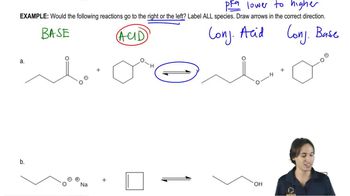
Determining Acid/Base Equilibrium

Henderson-Hasselbalch Equation

The Henderson-Hasselbalch equation relates pH, pKa, and the ratio of the concentrations of the deprotonated and protonated forms of an acid. It is expressed as pH = pKa + log([A-]/[HA]). This equation helps determine the predominant species in solution by comparing the pH to the pKa of the acid.
Video consigliato:
05:02
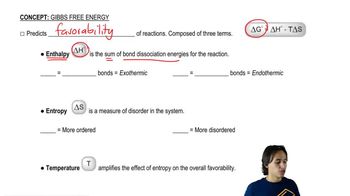
Breaking down the different terms of the Gibbs Free Energy equation.

Acid-Base Species in Solution

In an aqueous solution, acids can exist in two forms: the protonated (HA) and deprotonated (A-) forms. The predominant form at a specific pH depends on the acid's pKa relative to the solution's pH. For example, if the pH is higher than the pKa, the deprotonated form is favored, while a lower pH favors the protonated form.
Video consigliato:
02:49
The Lewis definition of acids and bases.