Ch. 20 - The Organic Chemistry of Carbohydrates
Bruice - Organic Chemistry 8th Edition
Bruice8th EditionOrganic ChemistryISBN: 9780135213711Non è quello che usi tu?Cambia libro di testo
Capitolo 20, Problema 62

A hexose is obtained when the residue of a shrub Sterculia setigeria undergoes acid-catalyzed hydrolysis. Identify the hexose from the following experimental information: it undergoes mutarotation; it does not react with Br2; and D-galactonic acid and D-talonic acid are formed when it reacts with Tollens’ reagent.

Guida verificata passo dopo passo
1
Step 1: Understand the problem and identify the key experimental observations. The hexose undergoes mutarotation, does not react with Br₂, and forms d-galactonic acid and d-talonic acid when treated with Tollens’ reagent. These observations provide clues about the structure and reactivity of the hexose.
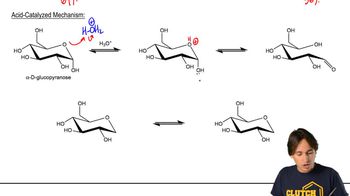
Step 2: Analyze the mutarotation property. Mutarotation occurs when a sugar exists in equilibrium between its α- and β-anomeric forms in solution, indicating the presence of a hemiacetal functional group. This suggests that the hexose is a reducing sugar.
Step 3: Consider the lack of reaction with Br₂. Bromine water selectively oxidizes aldehydes to carboxylic acids. The fact that the hexose does not react with Br₂ implies that it does not have a free aldehyde group in its open-chain form, suggesting it is a ketose rather than an aldose.
Step 4: Examine the reaction with Tollens’ reagent. Tollens’ reagent oxidizes reducing sugars to their corresponding aldonic acids. The formation of d-galactonic acid and d-talonic acid indicates that the hexose is epimeric at two positions, specifically at C-2 and C-4, which are characteristic of d-galactose and d-tagatose.
Step 5: Conclude the identity of the hexose. Based on the experimental data, the hexose must be d-tagatose, a ketose that undergoes mutarotation, does not react with Br₂, and forms d-galactonic acid and d-talonic acid upon oxidation with Tollens’ reagent.

Risposta video verificata per un problema simile:

Questa soluzione video è stata consigliata dai nostri tutor come utile per risolvere questo problema.
Durata del video:
5m

Concetti chiave

Ecco i concetti essenziali che devi comprendere per rispondere correttamente alla domanda.

Mutarotation

Mutarotation is the change in optical rotation that occurs when an α-anomer of a sugar converts to its β-anomer in solution. This process is significant for hexoses, as it indicates the presence of an anomeric carbon, which can interconvert between different cyclic forms. The observation of mutarotation in the hexose suggests it is a reducing sugar capable of forming an equilibrium between its anomeric forms.
Video consigliato:
03:06
Mechanism

Tollens' Reagent

Tollens' reagent is a solution of silver nitrate in ammonia, used to test for aldehydes and reducing sugars. When a sugar reacts with Tollens' reagent, it indicates the presence of an aldehyde functional group, which is characteristic of reducing sugars. The formation of d-galactonic acid and d-talonic acid upon reaction with Tollens' reagent suggests that the hexose in question has an aldehyde group that can be oxidized.
Video consigliato:
01:52
Reagents

Non-reaction with Br2

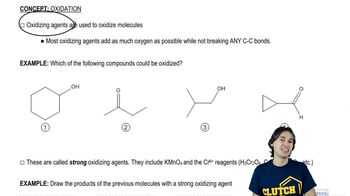
The non-reaction of a sugar with bromine (Br2) indicates that it is not a strong reducing agent, which is typical for certain hexoses. In organic chemistry, sugars that do not react with Br2 are often those that lack a free aldehyde group or are in a stable cyclic form. This characteristic helps narrow down the identity of the hexose, as it suggests that the sugar is likely a ketose or a specific aldose that does not readily oxidize.
Video consigliato:
06:42
Understanding Non-IUPAC Substituents
Pratica correlata
Domanda del libro di testo

The aldaric acid of D-glucose forms two five-membered-ring lactones. Draw their structures.

1460
views

Domanda del libro di testo

How many aldaric acids are obtained from the 16 aldohexoses?

1232
views
Domanda del libro di testo

The specific rotation of α-D-galactose is 150.7 and that of β-D-galactose is 52.8. When an aqueous mixture that was initially 70% α-D-galactose and 30% β-D-galactose reaches equilibrium, the specific rotation is 80.2. What is the percentage of α-D-galactose and β-D galactose at equilibrium?

1174
views
Domanda del libro di testo

Draw each of the following:

a. β-D-talopyranose

b. α-D-idopyranose  

790
views
Domanda del libro di testo

Hyaluronic acid, a component of connective tissue, is the fluid that lubricates joints. It is a polymer of alternating N-acetyl-D-glucosamine and D-glucuronic acid subunits joined by β-1,3′-glycosidic linkages. Draw a short segment of hyaluronic acid.

822
views
Domanda del libro di testo

Calculate the percentages of α\(\alpha\)-D-glucose and β\(\beta\)-D-glucose present at equilibrium from the specific rotations of α\(\alpha\)-D-glucose, β\(\beta\)-D-glucose, and the equilibrium mixture. Compare your values with those given in Section 20.10. (Hint: The specific rotation of the mixture equals the specific rotation of α\(\alpha\)-D-glucose times the fraction of glucose present in the a-form plus the specific rotation of β\(\beta\)-D-glucose times the fraction of glucose present in the β\(\beta\) -form.)

1029
views