Ch. 20 - The Organic Chemistry of Carbohydrates
Bruice - Organic Chemistry 8th Edition
Bruice8th EditionOrganic ChemistryISBN: 9780135213711Non è quello che usi tu?Cambia libro di testo
Capitolo 20, Problema 34b

What product or products are obtained when D-galactose reacts with each of the following?
b. Ag+, NH3, HO-

Guida verificata passo dopo passo
1
Identify the functional groups present in d-galactose. D-galactose is an aldose sugar, meaning it contains an aldehyde group (-CHO) at the anomeric carbon and multiple hydroxyl (-OH) groups.
Understand the reaction conditions. The reagents Ag+, NH3, and HO- together form Tollens' reagent, which is commonly used to oxidize aldehydes to carboxylic acids.
Recognize the specific reaction mechanism. Tollens' reagent oxidizes the aldehyde group (-CHO) in d-galactose to a carboxylate group (-COO⁻), forming the corresponding aldonic acid (in this case, d-galactonic acid).
Write the chemical equation for the reaction. The aldehyde group of d-galactose reacts with Tollens' reagent, resulting in the formation of d-galactonic acid and the reduction of Ag+ to metallic silver (Ag⁰).
Conclude that the product of this reaction is d-galactonic acid, and metallic silver is deposited as a byproduct. The hydroxyl groups on the sugar remain unchanged during this reaction.

Risposta video verificata per un problema simile:

Questa soluzione video è stata consigliata dai nostri tutor come utile per risolvere questo problema.
Durata del video:
1m

Concetti chiave

Ecco i concetti essenziali che devi comprendere per rispondere correttamente alla domanda.

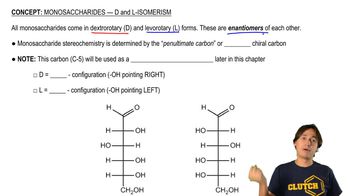
D-Galactose Structure

D-galactose is a monosaccharide with an aldehyde group and multiple hydroxyl groups. It is an aldohexose, meaning it contains six carbon atoms and an aldehyde functional group at one end. Understanding its structure is crucial for predicting its reactivity in chemical reactions, particularly in oxidation and reduction processes.
Video consigliato:
06:47
Monosaccharides - D and L Isomerism

Oxidation-Reduction Reactions

In organic chemistry, oxidation-reduction (redox) reactions involve the transfer of electrons between species. In the context of D-galactose reacting with Ag+ (silver ion), the aldehyde group can be oxidized to a carboxylic acid, while Ag+ is reduced to metallic silver. This transformation is essential for understanding the products formed in the reaction.
Video consigliato:
00:54
Distinguishing between Oxidation and Reduction

Complex Formation with Ammonia

Ammonia (NH3) can react with carbonyl compounds, such as the aldehyde in D-galactose, to form imines or amines. This reaction is significant in organic synthesis and can lead to the formation of various nitrogen-containing products. Recognizing how ammonia interacts with sugars is key to predicting the outcome of the reaction in question.
Video consigliato:
05:02
Coordination Complexes