Ch. 4 - Isomers: The Arrangement of Atoms in Space
Bruice - Organic Chemistry 8th Edition
Bruice8th EditionOrganic ChemistryISBN: 9780135213711Non è quello che usi tu?Cambia libro di testo
Capitolo 4, Problema 85

Butaclamol is a potent antipsychotic that has been used clinically in the treatment of schizophrenia. How many asymmetric centers does it have?

Guida verificata passo dopo passo
1
Step 1: Identify the definition of an asymmetric center. An asymmetric center (or chiral center) is a carbon atom that is bonded to four different groups or atoms.
Step 2: Examine the structure of Butaclamol provided in the image. Look for carbon atoms that are bonded to four distinct groups. Pay attention to stereochemical indicators such as wedges and dashed bonds, which denote 3D orientation.
Step 3: Locate the carbon atom attached to the hydroxyl group (OH), the tert-butyl group (C(CH3)3), a hydrogen atom, and the rest of the ring structure. This carbon is an asymmetric center because it is bonded to four different groups.
Step 4: Identify the second asymmetric center in the structure. Look for another carbon atom with stereochemical indicators (wedge and dashed bonds) that is bonded to four distinct groups. In this case, the carbon bonded to the nitrogen atom, a hydrogen atom, and two different ring systems qualifies as an asymmetric center.
Step 5: Count the total number of asymmetric centers in the molecule. Based on the analysis, there are two asymmetric centers in Butaclamol.

Risposta video verificata per un problema simile:

Questa soluzione video è stata consigliata dai nostri tutor come utile per risolvere questo problema.
Durata del video:
3m

Concetti chiave

Ecco i concetti essenziali che devi comprendere per rispondere correttamente alla domanda.

Asymmetric Centers

Asymmetric centers, or chiral centers, are carbon atoms that are bonded to four different substituents, leading to non-superimposable mirror images known as enantiomers. The presence of asymmetric centers in a molecule is crucial for determining its stereochemistry, which can significantly influence its biological activity and interactions.
Video consigliato:
03:38
How to add to asymmetrical double bonds.

Stereochemistry

Stereochemistry is the study of the spatial arrangement of atoms in molecules and how this arrangement affects their chemical properties and reactions. Understanding stereochemistry is essential in organic chemistry, especially for compounds like Butaclamol, as different stereoisomers can exhibit different pharmacological effects.
Video consigliato:
Percorso guidato
1:38
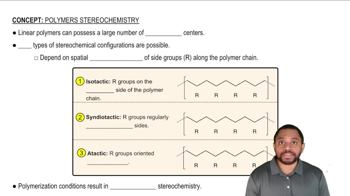
Polymer Stereochemistry Concept 1

Molecular Structure Analysis

Molecular structure analysis involves examining the arrangement of atoms within a molecule, often using techniques like spectroscopy or X-ray crystallography. This analysis helps identify features such as asymmetric centers, which are critical for understanding the compound's reactivity and interactions in biological systems.
Video consigliato:
08:41
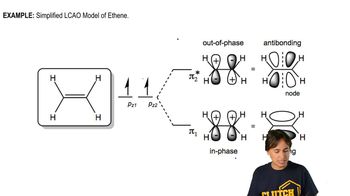
Review of Molecular Orbitals