Ch. 4 - Isomers: The Arrangement of Atoms in Space
Bruice - Organic Chemistry 8th Edition
Bruice8th EditionOrganic ChemistryISBN: 9780135213711Non è quello che usi tu?Cambia libro di testo
Capitolo 4, Problema 93d

Draw structures for the following:
d. a chiral stereoisomer of 1,2-dibromocyclobutane

Guida verificata passo dopo passo
1
Step 1: Draw the structure of 1,2-dibromocyclobutane. This is a cyclobutane ring (a four-membered carbon ring) with bromine atoms attached to two adjacent carbon atoms.
Step 2: Identify the chiral centers. In this case, the two carbon atoms attached to the bromine atoms are the chiral centers because they are attached to four different groups: a hydrogen atom, a bromine atom, and two different carbon atoms.
Step 3: Draw a chiral stereoisomer by changing the configuration at one of the chiral centers. This can be done by swapping the positions of two groups attached to the chiral center. For example, you can swap the positions of the hydrogen and bromine atoms on one of the chiral centers.
Step 4: Verify that the new structure is indeed a chiral stereoisomer. It should be non-superimposable on its mirror image, and it should not be identical to the original 1,2-dibromocyclobutane structure.
Step 5: Finally, label the chiral centers in the new structure with R or S configuration, according to the Cahn-Ingold-Prelog priority rules. This step is not necessary for drawing the structure, but it can help you confirm that you have indeed drawn a chiral stereoisomer.

Risposta video verificata per un problema simile:

Questa soluzione video è stata consigliata dai nostri tutor come utile per risolvere questo problema.
Durata del video:
1m

Concetti chiave

Ecco i concetti essenziali che devi comprendere per rispondere correttamente alla domanda.

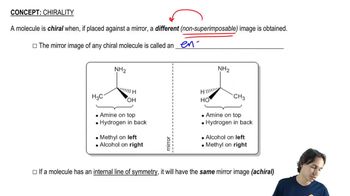
Chirality

Chirality refers to the geometric property of a molecule that makes it non-superimposable on its mirror image. A chiral molecule typically has at least one carbon atom bonded to four different substituents, resulting in two distinct stereoisomers, known as enantiomers. Understanding chirality is crucial for identifying and drawing chiral structures, as it influences the molecule's optical activity and interactions in biological systems.
Video consigliato:
05:10
What is chirality?

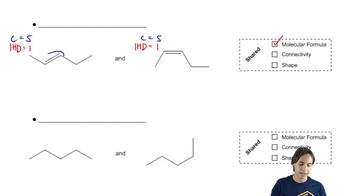
Stereoisomers

Stereoisomers are compounds that have the same molecular formula and connectivity of atoms but differ in the spatial arrangement of their atoms. This category includes enantiomers, which are non-superimposable mirror images, and diastereomers, which are not mirror images. Recognizing the types of stereoisomers is essential for drawing accurate structures and understanding their chemical behavior.
Video consigliato:
01:58
Determining when molecules are stereoisomers.

Cyclobutane Structure

Cyclobutane is a four-membered carbon ring that can adopt various conformations due to its angle strain and flexibility. The presence of substituents, such as bromine atoms in 1,2-dibromocyclobutane, can influence the ring's conformation and the resulting stereochemistry. When drawing chiral stereoisomers of cyclobutane, it is important to consider the orientation of substituents to ensure the correct representation of chirality.
Video consigliato:
03:04
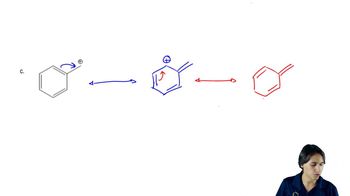
Drawing Resonance Structures