Ch. 4 - Isomers: The Arrangement of Atoms in Space
Bruice - Organic Chemistry 8th Edition
Bruice8th EditionOrganic ChemistryISBN: 9780135213711Non è quello che usi tu?Cambia libro di testo
Capitolo 4, Problema 6

Which of the following compounds have a dipole moment of zero?

Guida verificata passo dopo passo
1
Step 1: Understand the concept of dipole moment. Dipole moment arises due to the difference in electronegativity between atoms in a molecule and the asymmetry in the molecular geometry. A molecule will have a dipole moment of zero if the individual bond dipoles cancel each other out due to symmetry.
Step 2: Analyze compound A. The molecule has two chlorine atoms and two hydrogen atoms symmetrically arranged around the double bond. The molecule is symmetrical, and the bond dipoles cancel each other out, resulting in a dipole moment of zero.
Step 3: Analyze compound B. The molecule has one chlorine atom and one hydrogen atom on each carbon of the double bond. The arrangement is not symmetrical, and the bond dipoles do not cancel each other out, resulting in a nonzero dipole moment.
Step 4: Analyze compound C. The molecule has two chlorine atoms on one carbon and two hydrogen atoms on the other carbon of the double bond. This arrangement is asymmetrical, and the bond dipoles do not cancel each other out, resulting in a nonzero dipole moment.
Step 5: Analyze compound D. The molecule has one chlorine atom and one hydrogen atom on each carbon of the double bond, but the arrangement is symmetrical. The bond dipoles cancel each other out, resulting in a dipole moment of zero.

Risposta video verificata per un problema simile:

Questa soluzione video è stata consigliata dai nostri tutor come utile per risolvere questo problema.
Durata del video:
2m

Concetti chiave

Ecco i concetti essenziali che devi comprendere per rispondere correttamente alla domanda.

Dipole Moment

A dipole moment is a measure of the separation of positive and negative charges in a molecule. It occurs when there is an uneven distribution of electron density, leading to a polar bond. The dipole moment is a vector quantity, having both magnitude and direction, and is crucial for understanding molecular polarity and interactions.
Video consigliato:
01:46
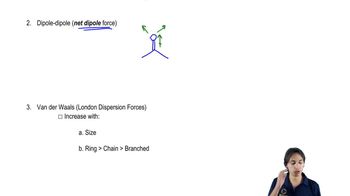
How dipole-dipole forces work.

Molecular Symmetry

Molecular symmetry refers to the balanced arrangement of atoms in a molecule. Symmetrical molecules, such as those with a uniform distribution of charge, often have a dipole moment of zero. Understanding symmetry helps predict the physical properties of molecules, including their polarity and reactivity.
Video consigliato:
00:25
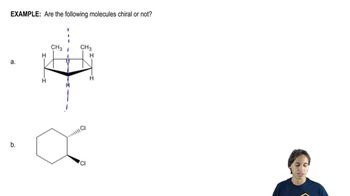
Determining Chirality with Plane of Symmetry

Polar vs. Nonpolar Molecules

Polar molecules have a significant dipole moment due to the presence of polar bonds and an asymmetrical shape, while nonpolar molecules have no net dipole moment. Nonpolar molecules can arise from symmetrical arrangements of identical atoms or from the cancellation of dipole moments in larger molecules, making it essential to analyze molecular structure to determine polarity.
Video consigliato:
2:04
Molecular Polarity