Ch. 6 - The Reactions of Alkenes • The Stereochemistry of Addition Reactions
Bruice - Organic Chemistry 8th Edition
Bruice8th EditionOrganic ChemistryISBN: 9780135213711Non è quello che usi tu?Cambia libro di testo
Capitolo 6, Problema 1

Draw the mechanism for the reaction of cyclohexene with HCl

Guida verificata passo dopo passo
1
Identify the reactants: cyclohexene is an alkene, and HCl is a strong acid.
Recognize that the reaction involves the addition of HCl across the double bond of cyclohexene.
Protonate the double bond: The π electrons of the double bond attack the hydrogen of HCl, forming a carbocation intermediate on the more substituted carbon.
Consider the stability of the carbocation: In this case, the carbocation forms on the more substituted carbon of cyclohexene, which is more stable.
Complete the reaction by having the chloride ion (Cl⁻) attack the carbocation, resulting in the formation of chlorocyclohexane.

Risposta video verificata per un problema simile:

Questa soluzione video è stata consigliata dai nostri tutor come utile per risolvere questo problema.
Durata del video:
3m

Concetti chiave

Ecco i concetti essenziali che devi comprendere per rispondere correttamente alla domanda.

Electrophilic Addition

Electrophilic addition is a fundamental reaction mechanism in organic chemistry where an electrophile reacts with a nucleophile, resulting in the formation of a more saturated product. In the case of cyclohexene and HCl, the double bond in cyclohexene acts as a nucleophile, attacking the electrophilic hydrogen in HCl, leading to the formation of a carbocation intermediate.
Video consigliato:
09:23
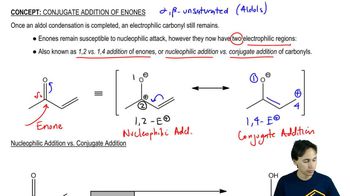
1,2 vs 1,4 Addition

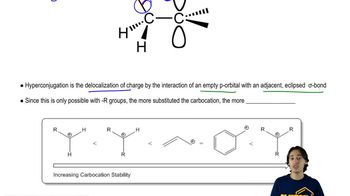
Carbocation Stability

Carbocation stability is crucial in understanding reaction mechanisms involving electrophilic addition. Carbocations are positively charged species that can vary in stability based on their structure; tertiary carbocations are more stable than secondary or primary ones. In the reaction of cyclohexene with HCl, the formation of a more stable carbocation intermediate influences the pathway and products of the reaction.
Video consigliato:
05:58
Determining Carbocation Stability

Regioselectivity

Regioselectivity refers to the preference of a chemical reaction to yield one structural isomer over others when multiple possibilities exist. In the reaction of cyclohexene with HCl, the regioselectivity is determined by the stability of the carbocation formed during the reaction, leading to the major product being the more stable alkyl halide, which is influenced by the position of the double bond in cyclohexene.
Video consigliato:
05:09
Heck Reaction