Ch. 6 - The Reactions of Alkenes • The Stereochemistry of Addition Reactions
Bruice - Organic Chemistry 8th Edition
Bruice8th EditionOrganic ChemistryISBN: 9780135213711Non è quello che usi tu?Cambia libro di testo
Capitolo 6, Problema 34a

The following product was obtained from the ozonolysis of an alkene followed by treatment with dimethyl sulfide. What is the structure of the alkene?
a.

Guida verificata passo dopo passo
1
Step 1: Understand the reaction. Ozonolysis is a reaction where an alkene is cleaved by ozone (O₃) to form carbonyl compounds. When followed by treatment with dimethyl sulfide (DMS), the reaction produces aldehydes or ketones depending on the structure of the alkene.
Step 2: Analyze the product. The given product is a ketone, specifically cyclohexanone. This indicates that the alkene was cleaved to form this cyclic ketone.
Step 3: Determine the structure of the original alkene. Since ozonolysis cleaves the double bond and forms carbonyl groups, the original alkene must have been a cyclic compound with a double bond in the ring. The double bond would have been located between two adjacent carbons in the cyclohexane ring.
Step 4: Reconstruct the alkene. To form cyclohexanone upon ozonolysis, the original alkene must have been cyclohexene, which has a double bond in the ring.
Step 5: Verify the reasoning. Cyclohexene undergoes ozonolysis to produce cyclohexanone when treated with dimethyl sulfide. This matches the given product, confirming the structure of the original alkene.

Risposta video verificata per un problema simile:

Questa soluzione video è stata consigliata dai nostri tutor come utile per risolvere questo problema.
Durata del video:
1m

Concetti chiave

Ecco i concetti essenziali che devi comprendere per rispondere correttamente alla domanda.

Ozonolysis

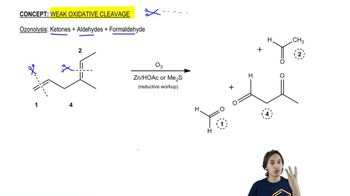
Ozonolysis is a reaction involving the cleavage of alkenes using ozone (O3) to form carbonyl compounds, such as aldehydes and ketones. The process typically occurs in two steps: first, the alkene reacts with ozone to form a molozonide, which rearranges to form ozonides. These ozonides can then be reduced to yield the final carbonyl products, providing insight into the structure of the original alkene.
Video consigliato:
06:30
General properties of ozonolysis.

Dimethyl Sulfide (DMS) Reduction

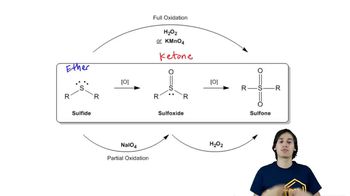
Dimethyl sulfide (DMS) is commonly used as a reducing agent in organic chemistry, particularly in the context of ozonolysis. After the formation of carbonyl compounds from ozonolysis, DMS can reduce these intermediates to their corresponding alcohols or further stabilize the products. Understanding this reduction step is crucial for determining the final structure of the compounds formed from the original alkene.
Video consigliato:
03:51
Reagents used to oxidize Sulfides.

Alkene Structure and Isomerism

The structure of alkenes is characterized by the presence of a carbon-carbon double bond, which can lead to geometric isomerism (cis/trans) and structural isomerism. Recognizing the possible configurations and the implications of the double bond is essential for deducing the original alkene from the products of ozonolysis. This understanding helps in predicting the outcomes of reactions and the relationships between different isomers.
Video consigliato:
06:47
Monosaccharides - D and L Isomerism