Ch. 6 - The Reactions of Alkenes • The Stereochemistry of Addition Reactions
Bruice - Organic Chemistry 8th Edition
Bruice8th EditionOrganic ChemistryISBN: 9780135213711Non è quello che usi tu?Cambia libro di testo
Capitolo 6, Problema 90

The reaction of an alkene with diazomethane forms a cyclopropane ring. Propose a mechanism for the reaction. (Hint: It is a concerted reaction.)

Guida verificata passo dopo passo
1
Step 1: Recognize that diazomethane (CH₂N₂) is a highly reactive compound due to the presence of a diazo group (-N≡N) and a negatively charged carbon atom. This makes it a good nucleophile and a source of carbene intermediates.
Step 2: Understand that the reaction is concerted, meaning all bond-making and bond-breaking events occur simultaneously in a single step. The alkene (CH₂=CH₂) acts as an electron-rich species, while diazomethane provides the carbene intermediate.
Step 3: Propose the mechanism: The diazomethane undergoes decomposition to generate a carbene (CH₂:), which is a neutral species with a divalent carbon atom and two nonbonding electrons. This carbene is highly reactive and interacts with the alkene.
Step 4: The carbene reacts with the alkene in a concerted manner. The π-electrons of the alkene attack the carbene, forming two new σ-bonds simultaneously, resulting in the formation of a cyclopropane ring.
Step 5: During the reaction, nitrogen gas (N₂) is released as a byproduct due to the decomposition of diazomethane. This release of N₂ drives the reaction forward energetically.

Risposta video verificata per un problema simile:

Questa soluzione video è stata consigliata dai nostri tutor come utile per risolvere questo problema.
Durata del video:
3m

Concetti chiave

Ecco i concetti essenziali che devi comprendere per rispondere correttamente alla domanda.

Alkenes

Alkenes are hydrocarbons that contain at least one carbon-carbon double bond (C=C). This double bond is a site of reactivity, making alkenes important in organic synthesis. Their ability to undergo addition reactions allows them to react with various reagents, leading to the formation of more complex structures, such as cyclopropanes.
Video consigliato:
Percorso guidato
2:09
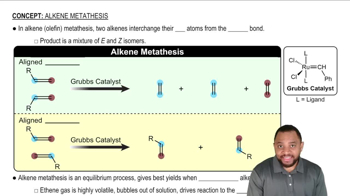
Alkene Metathesis Concept 1

Concerted Reactions

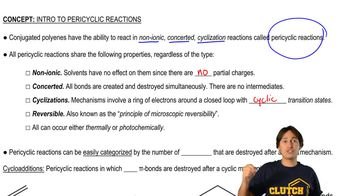
Concerted reactions are processes in which bond-breaking and bond-forming occur simultaneously in a single step, without intermediates. This type of mechanism is characterized by a transition state where all changes happen at once. Understanding concerted mechanisms is crucial for predicting the outcome of reactions, such as the formation of cyclopropanes from alkenes and diazomethane.
Video consigliato:
07:37
Properties and Types of Pericyclic Reactions

Cyclopropane Formation

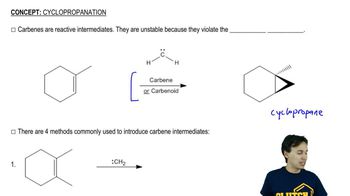
Cyclopropane formation involves the addition of a reagent across the double bond of an alkene, resulting in a three-membered ring structure. This reaction is typically facilitated by the presence of a reactive species, such as diazomethane, which can insert into the double bond. The unique strain and reactivity of cyclopropanes make them interesting intermediates in organic synthesis.
Video consigliato:
01:49
General properties of cyclopropanation.