Ch. 6 - The Reactions of Alkenes • The Stereochemistry of Addition Reactions
Bruice - Organic Chemistry 8th Edition
Bruice8th EditionOrganic ChemistryISBN: 9780135213711Non è quello che usi tu?Cambia libro di testo
Capitolo 6, Problema 8b

What alkene should be used to synthesize each of the following alkyl bromides?
b.

Guida verificata passo dopo passo
1
Analyze the given alkyl bromide structure: The molecule consists of a cyclohexane ring attached to a CH2 group, which is further connected to a CH group bonded to a bromine atom and a CH3 group.
Determine the reaction type: The synthesis of alkyl bromides from alkenes typically involves an electrophilic addition reaction where HBr adds across the double bond of an alkene.
Identify the position of bromine: Bromine is attached to the secondary carbon (CH) in the side chain. This suggests that the alkene used should have a double bond between the CH2 group and the CH group in the side chain.
Propose the alkene structure: The alkene should have a cyclohexane ring attached to a CH2 group, which is connected to a CH group with a double bond to a CH2 group. This structure ensures that HBr can add across the double bond to place bromine on the secondary carbon.
Explain the regioselectivity: The addition of HBr follows Markovnikov's rule, where the bromine atom attaches to the more substituted carbon (secondary carbon in this case) due to the stability of the carbocation intermediate formed during the reaction.

Risposta video verificata per un problema simile:

Questa soluzione video è stata consigliata dai nostri tutor come utile per risolvere questo problema.
Durata del video:
4m

Concetti chiave

Ecco i concetti essenziali che devi comprendere per rispondere correttamente alla domanda.

Alkene Reactivity

Alkenes are unsaturated hydrocarbons characterized by at least one carbon-carbon double bond. Their reactivity is primarily due to this double bond, which can undergo various reactions, including electrophilic addition. Understanding the reactivity of alkenes is crucial for predicting the products formed when they react with halogens, such as bromine, to create alkyl bromides.
Video consigliato:
Percorso guidato
2:09
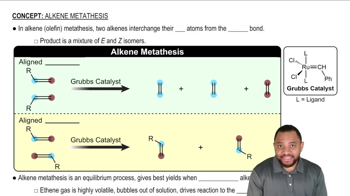
Alkene Metathesis Concept 1

Electrophilic Addition Mechanism

The electrophilic addition mechanism involves the attack of an electrophile on the electron-rich double bond of an alkene. In the case of bromination, bromine (Br2) acts as the electrophile, leading to the formation of a bromonium ion intermediate. This mechanism is essential for determining how to synthesize specific alkyl bromides from alkenes, as it dictates the regioselectivity and stereochemistry of the product.
Video consigliato:
05:39
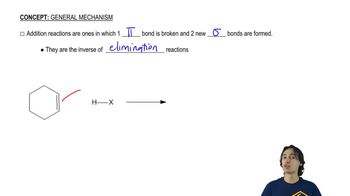
Features of Addition Mechanisms.

Regioselectivity

Regioselectivity refers to the preference of a chemical reaction to yield one structural isomer over others when multiple products are possible. In the context of alkene reactions, the Markovnikov rule often applies, stating that the more substituted carbon atom will bond with the electrophile. Understanding regioselectivity is vital for selecting the appropriate alkene to synthesize a desired alkyl bromide, ensuring the correct product is formed.
Video consigliato:
05:09
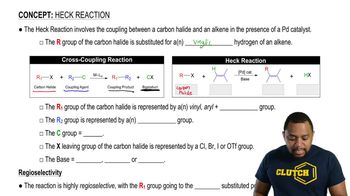
Heck Reaction