Ch. 6 - The Reactions of Alkenes • The Stereochemistry of Addition Reactions
Bruice - Organic Chemistry 8th Edition
Bruice8th EditionOrganic ChemistryISBN: 9780135213711Non è quello che usi tu?Cambia libro di testo
Capitolo 6, Problema 81b

What is the major product of each of the following reactions?
b. Chemical reaction showing the addition of Br2 to an alkene, resulting in a halohydrin product.

Guida verificata passo dopo passo
1
Analyze the structure of the given molecule. It contains a hydroxyl group (-OH) and a double bond (alkene) in the chain. The reaction involves bromine (Br₂) in CH₂Cl₂, which is a typical reagent for electrophilic addition to alkenes.
Understand the mechanism of the reaction. Bromine reacts with the alkene via an electrophilic addition mechanism. The π-electrons of the double bond attack the bromine molecule, forming a bromonium ion intermediate.
Determine the regioselectivity and stereoselectivity of the reaction. Bromine adds across the double bond in an anti-addition manner, meaning the two bromine atoms will be added to opposite sides of the double bond.
Identify the major product. The bromine atoms will add to the carbons of the double bond, resulting in a vicinal dibromide. The hydroxyl group (-OH) does not participate in this reaction and remains unchanged.
Draw the final structure of the major product. The double bond is replaced by two bromine atoms attached to the carbons that were part of the double bond, and the stereochemistry reflects anti-addition.

Risposta video verificata per un problema simile:

Questa soluzione video è stata consigliata dai nostri tutor come utile per risolvere questo problema.
Durata del video:
6m

Concetti chiave

Ecco i concetti essenziali che devi comprendere per rispondere correttamente alla domanda.

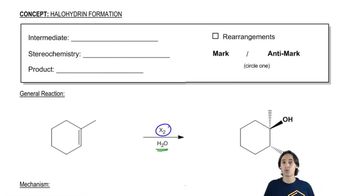
Halohydrin Formation

Halohydrin formation is a reaction where alkenes react with halogens (like Br2) in the presence of water or alcohols to form halohydrins. This process involves the electrophilic addition of the halogen to the double bond, followed by the nucleophilic attack of water or alcohol on the more substituted carbon, leading to the formation of a halohydrin product.
Video consigliato:
01:44
General properties of halohydrin formation.

Regioselectivity

Regioselectivity refers to the preference of a chemical reaction to yield one structural isomer over others when multiple possibilities exist. In the case of halohydrin formation, the regioselectivity is influenced by the stability of the carbocation intermediate formed during the reaction, favoring the more substituted carbon atom for the nucleophilic attack.
Video consigliato:
05:09
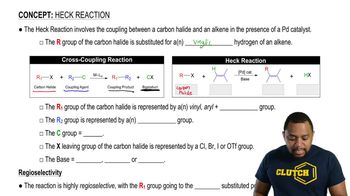
Heck Reaction

Solvent Effects

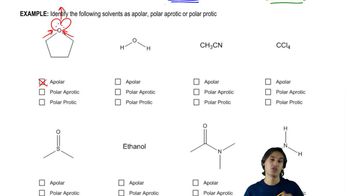
The choice of solvent can significantly influence the outcome of a chemical reaction. In this case, CH2Cl2 (dichloromethane) is a non-polar solvent that can stabilize the halogen and facilitate the reaction without participating in it. The solvent's properties can affect the reaction rate and the regioselectivity of the halohydrin formation.
Video consigliato:
01:16
Identification of polarity in solvents