Ch. 6 - The Reactions of Alkenes • The Stereochemistry of Addition Reactions
Bruice - Organic Chemistry 8th Edition
Bruice8th EditionOrganic ChemistryISBN: 9780135213711Non è quello che usi tu?Cambia libro di testo
Capitolo 6, Problema 66f

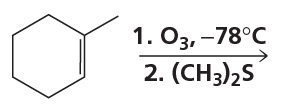
What is the major product of each of the following reactions?
f. Chemical reaction diagram showing ozonolysis of a cyclic compound with reaction conditions and reagents listed.

Guida verificata passo dopo passo
1
Identify the type of reaction taking place (e.g., substitution, elimination, addition, etc.) by analyzing the reactants and reaction conditions provided in the problem.
Determine the functional groups present in the starting material and how they might interact with the reagents or catalysts provided.
Consider the regioselectivity and stereoselectivity of the reaction. For example, if the reaction involves an electrophilic addition to an alkene, apply Markovnikov's or anti-Markovnikov's rule as appropriate.
Draw the reaction mechanism step by step, showing the movement of electrons using curved arrows. This will help you visualize how the reactants are converted into the product.
Analyze the stability of possible intermediates (e.g., carbocations, radicals) and predict the most stable intermediate, which will lead to the major product.

Risposta video verificata per un problema simile:

Questa soluzione video è stata consigliata dai nostri tutor come utile per risolvere questo problema.
Durata del video:
3m

Concetti chiave

Ecco i concetti essenziali che devi comprendere per rispondere correttamente alla domanda.

Reaction Mechanisms

Understanding reaction mechanisms is crucial in organic chemistry as they describe the step-by-step process by which reactants transform into products. This includes identifying intermediates, transition states, and the movement of electrons. Knowledge of mechanisms helps predict the major products of reactions based on the stability of intermediates and the energy changes involved.
Video consigliato:
02:16
Heck Reaction Mechanism

Functional Groups

Functional groups are specific groups of atoms within molecules that are responsible for the characteristic chemical reactions of those molecules. Recognizing functional groups allows chemists to predict how different compounds will react under various conditions. The nature of the functional groups involved in a reaction significantly influences the major product formed.
Video consigliato:
02:36
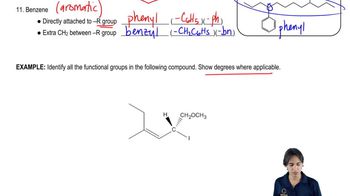
Identifying Functional Groups

Regioselectivity and Stereoselectivity

Regioselectivity refers to the preference of a chemical reaction to yield one structural isomer over others, while stereoselectivity involves the preference for one stereoisomer over another. These concepts are essential for determining the major product in reactions where multiple products are possible. Understanding these selectivities helps in predicting the outcome of reactions based on the conditions and reactants used.
Video consigliato:
05:09
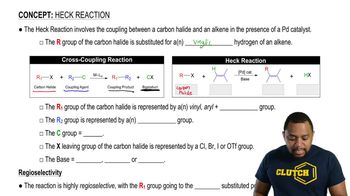
Heck Reaction