When fumarate reacts with D2O in the presence of the enzyme fumarase, only one isomer of the product is formed, as shown here. Is the enzyme catalyzing a syn or an anti addition of D2O?
Ch. 6 - The Reactions of Alkenes • The Stereochemistry of Addition Reactions
Tutti i libri di testo
Bruice 8th Edition
Ch. 6 - The Reactions of Alkenes • The Stereochemistry of Addition Reactions
Problema 97
Bruice 8th Edition
Ch. 6 - The Reactions of Alkenes • The Stereochemistry of Addition Reactions
Problema 97Capitolo 6, Problema 97
Which compound is hydrated more rapidly?

Guida verificata passo dopo passo1
Step 1: Analyze the chemical structures provided. The first compound is isobutene (CH3CH=C(CH3)2), and the second compound is 3-chloro-2-methylpropene (ClCH2CH=C(CH3)2). Both compounds contain a double bond, which is the site of hydration.
Step 2: Recall the Markovnikov's rule for hydration reactions. In the presence of an acid catalyst, water adds to the double bond such that the hydrogen atom attaches to the carbon with more hydrogen atoms, and the hydroxyl group attaches to the carbon with fewer hydrogen atoms.
Step 3: Consider the electronic effects. The chlorine atom in the second compound is an electron-withdrawing group due to its electronegativity. This can stabilize the carbocation intermediate formed during the hydration process, making the second compound more reactive toward hydration.
Step 4: Evaluate steric effects. The presence of bulky groups near the double bond can hinder the approach of water molecules. In this case, both compounds have similar steric hindrance around the double bond, so steric effects are not a major differentiating factor.
Step 5: Conclude that the compound with the electron-withdrawing chlorine atom (3-chloro-2-methylpropene) is hydrated more rapidly due to the stabilization of the carbocation intermediate during the reaction.

Risposta video verificata per un problema simile:
Questa soluzione video è stata consigliata dai nostri tutor come utile per risolvere questo problema.
Durata del video:
4mConcetti chiave
Ecco i concetti essenziali che devi comprendere per rispondere correttamente alla domanda.
Hydration Reaction
A hydration reaction involves the addition of water to a compound, typically resulting in the formation of a hydrate. This process is crucial in organic chemistry as it affects the stability and reactivity of compounds. The rate of hydration can depend on factors such as the structure of the compound and the presence of functional groups that can interact favorably with water.
Video consigliato:
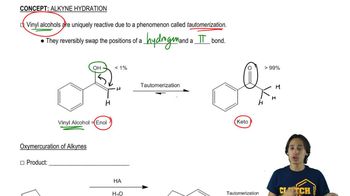
Alkyne Hydration
Steric Hindrance
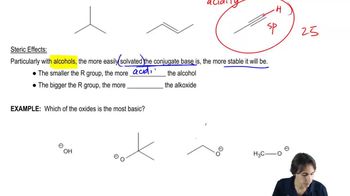
Steric hindrance refers to the prevention of chemical reactions due to the spatial arrangement of atoms within a molecule. Bulky groups can impede the approach of water molecules to the reactive site, thus slowing down the hydration process. Understanding steric effects is essential for predicting the reactivity of different compounds in hydration reactions.
Video consigliato:
Understanding steric effects.
Polarity and Solubility
Polarity is a key factor in determining how well a compound interacts with water, which is a polar solvent. Compounds that are more polar or have functional groups capable of hydrogen bonding with water will generally hydrate more rapidly. This concept is vital for understanding the solubility and reactivity of organic compounds in aqueous environments.
Video consigliato:
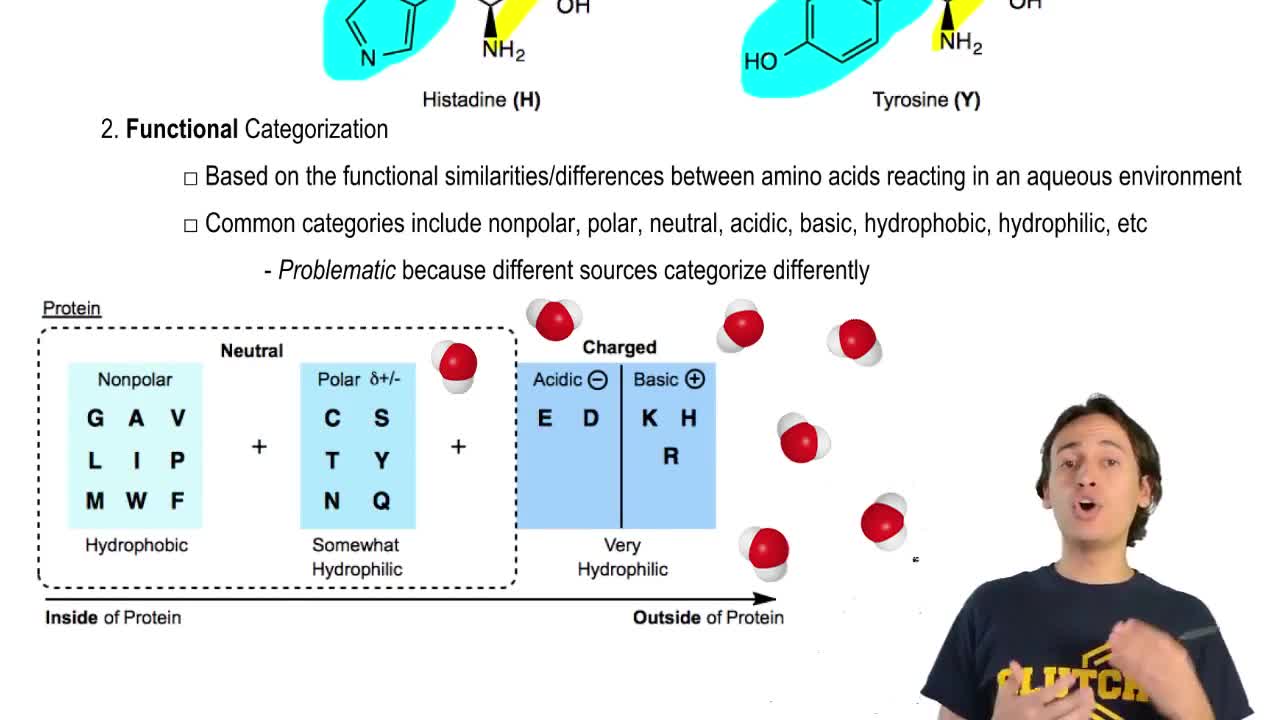
Functional Classification
Pratica correlata
Domanda del libro di testo
1143
views
Domanda del libro di testo
What stereoisomers are obtained when (S)-3-methyl-1-pentene reacts with Cl2?
1306
views
Domanda del libro di testo
a. Propose a mechanism for the following reaction:
b. Is the initially formed carbocation primary, secondary, or tertiary?
c. Is the rearranged carbocation primary, secondary, or tertiary?
d. Why does the rearrangement occur?
1485
views
1
rank
Domanda del libro di testo
Draw the products of the following reactions, including their configurations:
1542
views
Domanda del libro di testo
Draw the products of the following reactions, including their configurations:
1470
views
Domanda del libro di testo
When the following compound is hydrated in the presence of acid, the unreacted alkene is found to have retained the deuterium atoms. What does this tell you about the mechanism for hydration?
1199
views