Ch. 6 - The Reactions of Alkenes • The Stereochemistry of Addition Reactions
Bruice - Organic Chemistry 8th Edition
Bruice8th EditionOrganic ChemistryISBN: 9780135213711Non è quello che usi tu?Cambia libro di testo
Capitolo 6, Problema 16a

Which of the following carbocations would you expect to rearrange?
Illustration of six carbocation structures labeled A to F, questioning which would likely undergo rearrangement.

Guida verificata passo dopo passo
1
Step 1: Analyze the stability of each carbocation. Carbocations rearrange to achieve greater stability, typically moving from primary to secondary or secondary to tertiary carbocations.
Step 2: Examine the first carbocation (cyclopentyl carbocation). It is a secondary carbocation, and rearrangement is unlikely unless a more stable tertiary carbocation can be formed.
Step 3: Examine the second carbocation (linear structure). This is a secondary carbocation, but it is adjacent to a quaternary carbon. A hydride shift could occur to form a tertiary carbocation, which is more stable.
Step 4: Examine the third carbocation (cyclopentyl with a methyl group). This is a secondary carbocation, and rearrangement is unlikely unless a more stable tertiary carbocation can be formed.
Step 5: Examine the fourth carbocation (cyclohexyl with an isopropyl group). This is a secondary carbocation, but a hydride or alkyl shift could occur to form a tertiary carbocation, which is more stable.

Risposta video verificata per un problema simile:

Questa soluzione video è stata consigliata dai nostri tutor come utile per risolvere questo problema.
Durata del video:
5m

Concetti chiave

Ecco i concetti essenziali che devi comprendere per rispondere correttamente alla domanda.

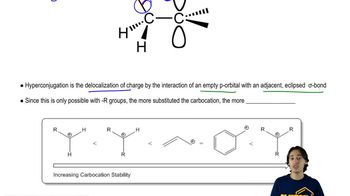
Carbocation Stability

Carbocations are positively charged carbon species that can rearrange to form more stable structures. The stability of a carbocation is influenced by the degree of substitution: tertiary carbocations are more stable than secondary, which are more stable than primary. This stability is due to hyperconjugation and the inductive effect from surrounding alkyl groups, which help to delocalize the positive charge.
Video consigliato:
05:58
Determining Carbocation Stability

Rearrangement Mechanisms

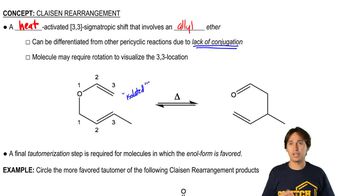
Carbocation rearrangements typically occur through mechanisms such as hydride shifts or alkyl shifts, where a neighboring atom or group moves to stabilize the carbocation. These shifts can lead to the formation of more stable carbocations, often resulting in a change in the molecular structure. Understanding these mechanisms is crucial for predicting which carbocations will rearrange.
Video consigliato:
06:08
Definition of Claisen Rearrangement

Ring Strain and Stability

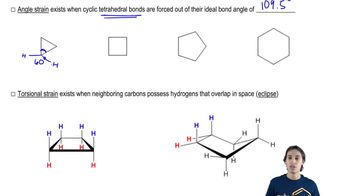
In cyclic carbocations, ring strain can significantly affect stability and the likelihood of rearrangement. Smaller rings, such as cyclopropyl or cyclobutyl, experience more strain and are less stable than larger rings. This strain can drive rearrangements as the system seeks to relieve the strain by forming a more stable structure, often leading to the opening of the ring or the formation of a more stable carbocation.
Video consigliato:
02:46
What is angle strain?