Ch. 6 - The Reactions of Alkenes • The Stereochemistry of Addition Reactions
Bruice - Organic Chemistry 8th Edition
Bruice8th EditionOrganic ChemistryISBN: 9780135213711Non è quello che usi tu?Cambia libro di testo
Capitolo 6, Problema 86

Which stereoisomer of 3,4-dimethyl-3-hexene forms (3S,4S)-3,4-dimethylhexane and (3R,4R)-3,4-dimethylhexane when it reacts with H2, Pd/C?

Guida verificata passo dopo passo
1
Identify the structure of 3,4-dimethyl-3-hexene. This molecule contains a double bond at the third carbon and methyl groups attached to both the third and fourth carbons. The stereoisomers arise due to the configuration around the double bond (E/Z isomerism).
Understand the reaction mechanism: The addition of H2 in the presence of Pd/C is a catalytic hydrogenation reaction. This process converts the double bond into a single bond by adding hydrogen atoms to the carbons involved in the double bond.
Determine the stereochemical outcome of the hydrogenation: Hydrogenation over Pd/C typically results in syn addition, meaning both hydrogen atoms are added to the same face of the double bond. This eliminates the double bond and creates a single bond, leading to the formation of stereoisomers.
Analyze the stereoisomers formed: The stereoisomers (3S,4S)-3,4-dimethylhexane and (3R,4R)-3,4-dimethylhexane are formed because the addition of hydrogen creates chiral centers at carbons 3 and 4. The stereochemistry of the original alkene determines which stereoisomers are produced.
Conclude which stereoisomer of 3,4-dimethyl-3-hexene leads to the given products: The (Z)-3,4-dimethyl-3-hexene stereoisomer will form (3S,4S)-3,4-dimethylhexane and (3R,4R)-3,4-dimethylhexane upon hydrogenation, as the syn addition of hydrogen preserves the relative configuration of the substituents on the double bond.

Risposta video verificata per un problema simile:

Questa soluzione video è stata consigliata dai nostri tutor come utile per risolvere questo problema.
Durata del video:
9m

Concetti chiave

Ecco i concetti essenziali che devi comprendere per rispondere correttamente alla domanda.

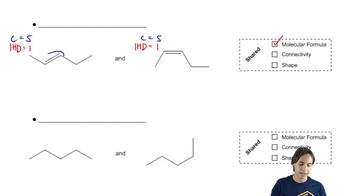
Stereoisomerism

Stereoisomerism refers to the phenomenon where compounds have the same molecular formula and connectivity of atoms but differ in the spatial arrangement of their atoms. This can lead to different physical and chemical properties. In organic chemistry, stereoisomers include enantiomers and diastereomers, which are crucial for understanding reactions involving chiral centers.
Video consigliato:
01:58
Determining when molecules are stereoisomers.

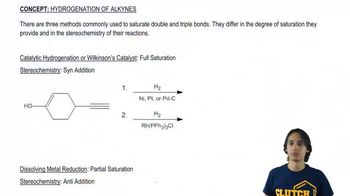
Hydrogenation

Hydrogenation is a chemical reaction that involves the addition of hydrogen (H2) to an unsaturated compound, typically in the presence of a catalyst like palladium on carbon (Pd/C). This process converts alkenes or alkynes into alkanes, affecting the stereochemistry of the resulting product. Understanding hydrogenation is essential for predicting the outcome of reactions involving alkenes.
Video consigliato:
00:48
The definition of hydrogenation.

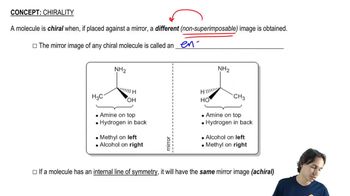
Chirality and Enantiomers

Chirality is a property of a molecule that makes it non-superimposable on its mirror image, often due to the presence of chiral centers (typically carbon atoms bonded to four different substituents). Enantiomers are pairs of chiral molecules that are mirror images of each other. The formation of specific enantiomers during reactions, such as hydrogenation, is critical for determining the stereochemical outcome of the reaction.
Video consigliato:
05:10
What is chirality?