Ch. 7 - The Reactions of Alkynes • An Introduction to Multistep Synthesis
Bruice - Organic Chemistry 8th Edition
Bruice8th EditionOrganic ChemistryISBN: 9780135213711Non è quello che usi tu?Cambia libro di testo
Capitolo 7, Problema 43(2)

a. Starting with 3-methyl-1-butyne, how can you prepare the following alcohols?
2. 3-methyl-1-butanol
b. In each case, a second alcohol would also be obtained. What alcohol would it be?

Guida verificata passo dopo passo
1
Step 1: Analyze the starting material, 3-methyl-1-butyne, which is a terminal alkyne. To convert it into an alcohol, consider the addition of water across the triple bond (hydration reaction).
Step 2: Use hydroboration-oxidation to achieve anti-Markovnikov addition of water. This involves two steps: (1) React 3-methyl-1-butyne with BH₃ (borane) or a borane derivative like 9-BBN to form an organoborane intermediate. (2) Oxidize the intermediate with H₂O₂ (hydrogen peroxide) in a basic solution (NaOH) to yield 3-methyl-1-butanol.
Step 3: Recognize that hydroboration-oxidation produces the anti-Markovnikov alcohol as the major product. However, a second alcohol can form as a minor product due to Markovnikov hydration. To achieve this, use acid-catalyzed hydration (H₂SO₄ and H₂O) in the presence of HgSO₄ (mercuric sulfate) as a catalyst.
Step 4: Acid-catalyzed hydration adds water across the triple bond in a Markovnikov manner, forming an enol intermediate. This enol tautomerizes to a ketone, which can then be reduced to form a secondary alcohol. The secondary alcohol in this case would be 3-methyl-2-butanol.
Step 5: Summarize the two alcohols obtained: (1) 3-methyl-1-butanol (anti-Markovnikov product from hydroboration-oxidation) and (2) 3-methyl-2-butanol (Markovnikov product from acid-catalyzed hydration followed by reduction).

Risposta video verificata per un problema simile:

Questa soluzione video è stata consigliata dai nostri tutor come utile per risolvere questo problema.
Durata del video:
6m

Concetti chiave

Ecco i concetti essenziali che devi comprendere per rispondere correttamente alla domanda.

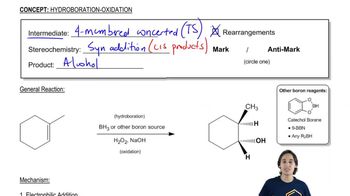
Alkyne Hydroboration-Oxidation

Hydroboration-oxidation is a two-step reaction used to convert alkynes into alcohols. In the first step, the alkyne reacts with diborane (B2H6) to form an organoborane intermediate. The second step involves oxidation with hydrogen peroxide (H2O2) and sodium hydroxide (NaOH), resulting in the formation of an alcohol. This method is particularly useful for synthesizing alcohols with specific stereochemistry.
Video consigliato:
06:38
General properties of hydroboration-oxidation.

Markovnikov's Rule

Markovnikov's Rule states that when HX (where X is a halogen or OH) adds to an alkene or alkyne, the hydrogen atom will attach to the carbon with the greater number of hydrogen atoms already attached. This principle helps predict the major product of the reaction, guiding the synthesis of specific alcohols from alkynes by determining the regioselectivity of the addition reactions.
Video consigliato:
03:54
The 18 and 16 Electron Rule

Rearrangement Reactions

Rearrangement reactions involve the structural reorganization of a molecule to form a more stable product. In the context of alcohol synthesis from alkynes, these reactions can lead to the formation of different alcohols, including secondary or tertiary alcohols, depending on the stability of the carbocation intermediates formed during the reaction. Understanding these rearrangements is crucial for predicting the outcome of the synthesis.
Video consigliato:
06:28
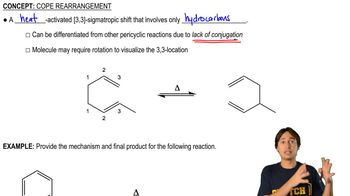
Definition of Cope Rearrangement