

Ch. 7 - The Reactions of Alkynes • An Introduction to Multistep Synthesis
Bruice - Organic Chemistry 8th Edition
Bruice8th EditionOrganic ChemistryISBN: 9780135213711Non è quello che usi tu?Cambia libro di testo
Capitolo 7, Problema 30k,l

Draw a condensed structure for each of the following:
k. cyclopentylacetylene
l. 5,6-dimethyl-2-heptyne

Guida verificata passo dopo passo
1
Identify the structure of the parent compound for each molecule. For part (k), the parent compound is 'cyclopentylacetylene,' which consists of a cyclopentyl group (a five-membered ring) attached to an acetylene group (a triple bond between two carbon atoms). For part (l), the parent compound is '2-heptyne,' which is a seven-carbon chain with a triple bond starting at the second carbon.
For part (k), draw the cyclopentyl group as a five-membered ring. Then, attach a carbon atom to the ring, which will form the acetylene group. Add a triple bond between this carbon and the next carbon atom to complete the acetylene group.
For part (l), start by drawing the seven-carbon chain for heptyne. Place a triple bond between the second and third carbons to represent the '2-heptyne' structure.
For part (l), add the substituents. The name '5,6-dimethyl' indicates that there are methyl groups (-CH₃) attached to the fifth and sixth carbons of the heptyne chain. Add these methyl groups to the appropriate positions.
Write the condensed structure for each compound. For part (k), the condensed structure will show the cyclopentyl group attached to the acetylene group. For part (l), the condensed structure will show the seven-carbon chain with the triple bond and the methyl substituents at the correct positions.

Risposta video verificata per un problema simile:

Questa soluzione video è stata consigliata dai nostri tutor come utile per risolvere questo problema.
Durata del video:
11m

Concetti chiave

Ecco i concetti essenziali che devi comprendere per rispondere correttamente alla domanda.

Condensed Structural Formula

A condensed structural formula is a way of representing a chemical compound that shows the arrangement of atoms and the connectivity between them without depicting all the bonds explicitly. It typically groups atoms together to indicate how they are connected, making it easier to visualize the structure of larger molecules. For example, in a condensed formula, carbon atoms in a chain may be written in sequence, with hydrogen atoms implied based on the tetravalency of carbon.
Video consigliato:
06:06
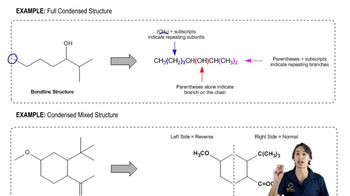
How to interpret condensed structures.

Alkynes

Alkynes are a class of hydrocarbons characterized by at least one carbon-carbon triple bond. They follow the general formula CnH2n-2, where 'n' is the number of carbon atoms. Alkynes are unsaturated compounds, which means they contain fewer hydrogen atoms than alkanes and alkenes, leading to unique reactivity and properties. Understanding the structure and naming conventions of alkynes is essential for drawing their condensed structures accurately.
Video consigliato:
09:11
Alkyne Hydration

Substituents in Organic Chemistry

Substituents are atoms or groups of atoms that replace hydrogen atoms in a hydrocarbon chain, influencing the compound's properties and reactivity. In the context of the given question, substituents like methyl groups (–CH3) can be attached to the main carbon chain, affecting the naming and structure of the compound. Recognizing how to identify and represent these substituents is crucial for accurately drawing condensed structures and understanding the overall molecular architecture.
Video consigliato:
00:56
What is an organic molecule?