Ch. 7 - The Reactions of Alkynes • An Introduction to Multistep Synthesis
Bruice - Organic Chemistry 8th Edition
Bruice8th EditionOrganic ChemistryISBN: 9780135213711Non è quello che usi tu?Cambia libro di testo
Capitolo 7, Problema 20f

What are products of the following reactions?
f.

Guida verificata passo dopo passo
1
Step 1: Identify the type of reaction. The given reaction involves an alkyne reacting with water in the presence of sulfuric acid (H₂SO₄). This is an example of an acid-catalyzed hydration of an alkyne.
Step 2: Understand the mechanism. In acid-catalyzed hydration, the alkyne undergoes electrophilic addition of water, facilitated by the acid catalyst. The reaction typically proceeds via the formation of an enol intermediate, which then tautomerizes to form a ketone.
Step 3: Analyze the structure of the alkyne. The alkyne shown is terminal, meaning the triple bond is at the end of the carbon chain. Terminal alkynes typically form methyl ketones as the major product in acid-catalyzed hydration reactions.
Step 4: Predict the intermediate. The addition of water across the triple bond forms an enol intermediate. The enol has a hydroxyl group (-OH) attached to one of the carbons of the former triple bond, and a double bond between the two carbons.
Step 5: Tautomerization to the final product. The enol intermediate undergoes tautomerization, a process where the hydroxyl group and the double bond rearrange to form a ketone. For this reaction, the final product will be a methyl ketone with the carbonyl group (C=O) on the second carbon of the chain.

Risposta video verificata per un problema simile:

Questa soluzione video è stata consigliata dai nostri tutor come utile per risolvere questo problema.
Durata del video:
3m

Concetti chiave

Ecco i concetti essenziali che devi comprendere per rispondere correttamente alla domanda.

Reaction Mechanisms

Understanding reaction mechanisms is crucial in organic chemistry as they describe the step-by-step process by which reactants transform into products. This includes identifying intermediates, transition states, and the movement of electrons. Familiarity with mechanisms helps predict the outcome of reactions and the stability of products formed.
Video consigliato:
02:16
Heck Reaction Mechanism

Functional Groups

Functional groups are specific groups of atoms within molecules that are responsible for the characteristic chemical reactions of those molecules. Recognizing functional groups allows chemists to predict reactivity and the types of products that can be formed in a reaction. Common functional groups include alcohols, carboxylic acids, and amines.
Video consigliato:
02:36
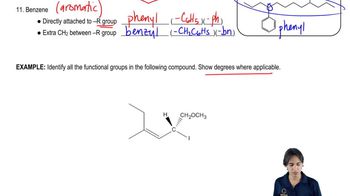
Identifying Functional Groups

Stoichiometry

Stoichiometry involves the calculation of reactants and products in chemical reactions. It is essential for determining the amounts of substances consumed and produced, ensuring that the law of conservation of mass is upheld. Mastery of stoichiometry allows chemists to balance equations and predict yields of reactions.
Video consigliato:
02:08
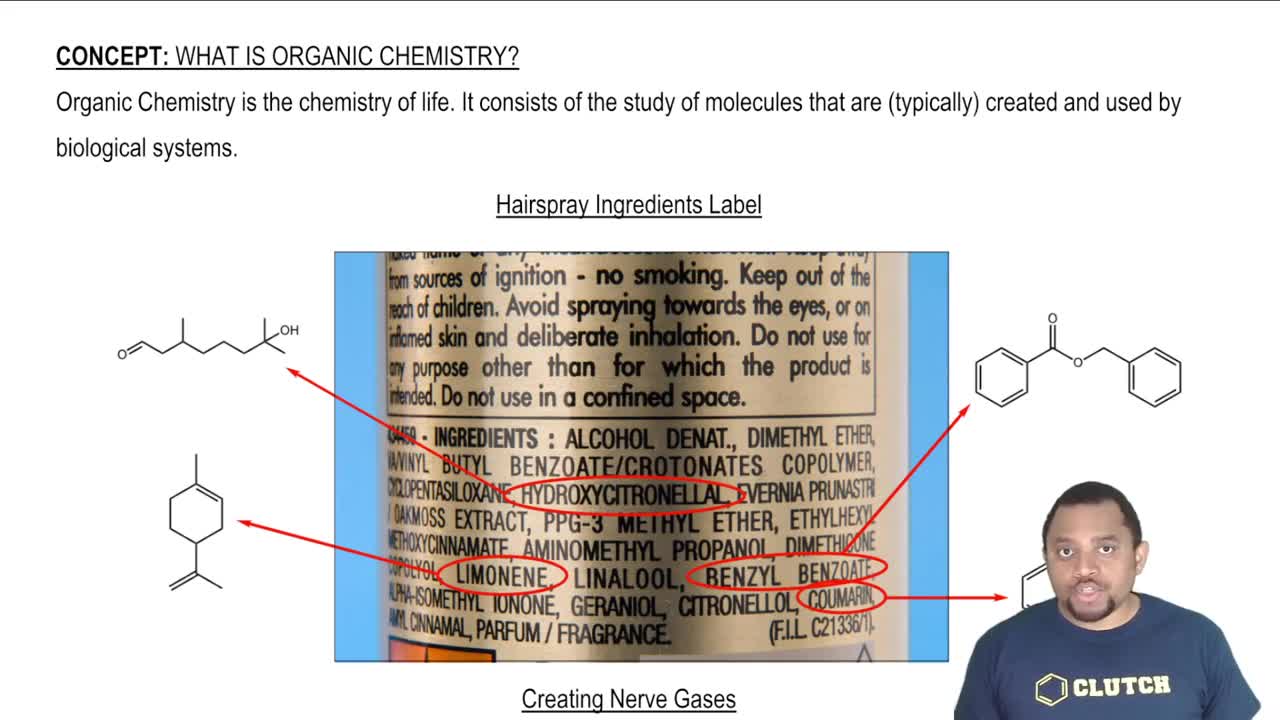
Organic molecules in your everyday life.