Ch. 7 - The Reactions of Alkynes • An Introduction to Multistep Synthesis
Bruice - Organic Chemistry 8th Edition
Bruice8th EditionOrganic ChemistryISBN: 9780135213711Non è quello che usi tu?Cambia libro di testo
Capitolo 7, Problema 39d

What is the major product of the reaction of 1 mol of propyne with each of the following reagents?
d. Br2 (2 mol)/CH2Cl2

Guida verificata passo dopo passo
1
Identify the structure of propyne (CH≡C-CH3), which is an alkyne with a terminal triple bond.
Understand that Br2 in CH2Cl2 is a halogenation reagent, and in the presence of an alkyne, it will add bromine atoms across the triple bond.
Since 2 moles of Br2 are used, the reaction will proceed in two steps: (1) addition of 1 mole of Br2 to convert the triple bond into a double bond, and (2) addition of the second mole of Br2 to convert the double bond into a single bond.
Write the mechanism for the first step: The π electrons of the triple bond attack one Br2 molecule, forming a bromonium ion intermediate. A bromide ion (Br⁻) then attacks the intermediate, resulting in a dibromoalkene (CHBr=CHBr-CH3).
Write the mechanism for the second step: The π electrons of the double bond in the dibromoalkene attack the second Br2 molecule, forming another bromonium ion intermediate. A bromide ion (Br⁻) attacks again, leading to the final product, a tetrabromoalkane (CHBr2-CHBr2-CH3).

Risposta video verificata per un problema simile:

Questa soluzione video è stata consigliata dai nostri tutor come utile per risolvere questo problema.
Durata del video:
4m

Concetti chiave

Ecco i concetti essenziali che devi comprendere per rispondere correttamente alla domanda.

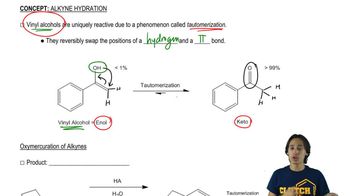
Alkyne Reactivity

Alkynes, such as propyne, are hydrocarbons with at least one carbon-carbon triple bond. They are more reactive than alkenes due to the presence of this triple bond, which can undergo various addition reactions. Understanding the reactivity of alkynes is crucial for predicting the products of their reactions with different reagents.
Video consigliato:
09:11
Alkyne Hydration

Electrophilic Addition

Electrophilic addition is a fundamental reaction mechanism in organic chemistry where an electrophile reacts with a nucleophile, leading to the formation of a more stable product. In the case of propyne reacting with bromine (Br2), the triple bond acts as a nucleophile, attacking the electrophilic bromine, resulting in the addition of bromine across the triple bond.
Video consigliato:
09:23
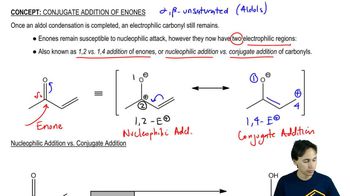
1,2 vs 1,4 Addition

Bromination of Alkynes

Bromination of alkynes involves the addition of bromine to the carbon-carbon triple bond, typically resulting in a dibrominated product. When 2 moles of Br2 are used, the reaction can lead to the formation of a vicinal dibromide, where bromine atoms are added to adjacent carbon atoms. This process is important for understanding how alkynes can be transformed into more complex molecules.
Video consigliato:
00:54
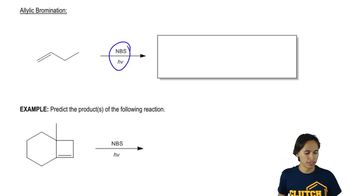
Mechanism of Allylic Bromination.