Ch. 7 - The Reactions of Alkynes • An Introduction to Multistep Synthesis
Bruice - Organic Chemistry 8th Edition
Bruice8th EditionOrganic ChemistryISBN: 9780135213711Non è quello che usi tu?Cambia libro di testo
Capitolo 7, Problema 34d

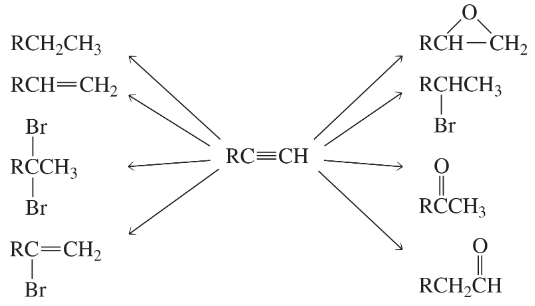
What reagents should be used to carry out the following syntheses?
Diagram illustrating alkyne halogenation reactions with various reagents and product structures.

Guida verificata passo dopo passo
1
Identify the starting material and the product. The starting material is an alkyne, and the product is an aldehyde.
Recognize that the transformation involves converting an alkyne to an aldehyde. This suggests a hydration reaction that stops at the aldehyde stage.
Consider the use of hydroboration-oxidation, which is a common method to convert terminal alkynes to aldehydes. This involves two main steps: hydroboration followed by oxidation.
For hydroboration, use a reagent like disiamylborane or 9-BBN (9-borabicyclo[3.3.1]nonane) to add across the triple bond in a syn addition manner.
For the oxidation step, use hydrogen peroxide (H₂O₂) in the presence of a base like sodium hydroxide (NaOH) to convert the boron intermediate into the aldehyde.

Risposta video verificata per un problema simile:

Questa soluzione video è stata consigliata dai nostri tutor come utile per risolvere questo problema.
Durata del video:
4m

Concetti chiave

Ecco i concetti essenziali che devi comprendere per rispondere correttamente alla domanda.

Hydroboration-Oxidation

Hydroboration-oxidation is a two-step reaction process used to convert alkenes or alkynes into alcohols. In the first step, an alkene or alkyne reacts with borane (BH3) to form an organoborane intermediate. The second step involves oxidation, typically using hydrogen peroxide (H2O2) in a basic solution, which converts the organoborane into an alcohol, resulting in anti-Markovnikov addition.
Video consigliato:
06:38
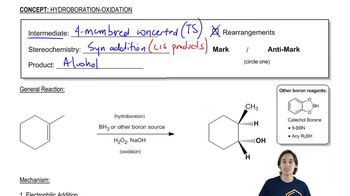
General properties of hydroboration-oxidation.

Reagents for Hydroboration

The primary reagents for hydroboration include borane (BH3) or its derivatives, such as diborane (B2H6), which can effectively add across the triple bond of an alkyne. These reagents are crucial for the initial step of the hydroboration process, allowing for the formation of the organoborane intermediate that will later be oxidized to yield the alcohol product.
Video consigliato:
06:38
General properties of hydroboration-oxidation.

Alkyne Reactivity

Alkynes are reactive compounds due to the presence of a carbon-carbon triple bond, which is more reactive than double or single bonds. This reactivity allows alkynes to undergo various addition reactions, including hydroboration. Understanding the reactivity of alkynes is essential for predicting the products of reactions and selecting appropriate reagents for synthesis.
Video consigliato:
09:11
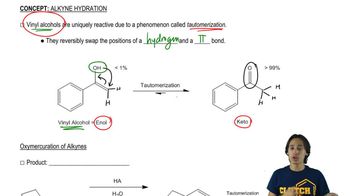
Alkyne Hydration