Ch. 8 - Delocalized Electrons: Their Effect on Stability, pKa, and the Products of a Reaction • Aromaticity and Electronic Effects: An Introduction to the Reactions of Benzene
Bruice - Organic Chemistry 8th Edition
Bruice8th EditionOrganic ChemistryISBN: 9780135213711Non è quello che usi tu?Cambia libro di testo
Capitolo 8, Problema 102a

Propose a mechanism for the following reaction:

Guida verificata passo dopo passo
1
Step 1: Analyze the reaction. The starting material is a ketone (2,6-dimethylcyclohex-2-enone), and the product is a phenol (2,6-dimethylphenol). The reaction involves acid-catalyzed aromatization, facilitated by H₂SO₄.
Step 2: Protonation of the ketone. The sulfuric acid (H₂SO₄) donates a proton (H⁺) to the carbonyl oxygen of the ketone, forming a protonated intermediate. This increases the electrophilicity of the carbonyl carbon.
Step 3: Enol formation. A tautomerization occurs where the protonated ketone undergoes enolization. The α-hydrogen adjacent to the carbonyl group is removed, and the double bond shifts to form an enol intermediate.
Step 4: Aromatization. The enol intermediate undergoes a series of proton transfers and elimination reactions to form the aromatic ring. This involves the loss of water and the formation of a conjugated π-system, resulting in the phenol structure.
Step 5: Deprotonation. The final step involves the removal of the proton from the hydroxyl group by the conjugate base of H₂SO₄, yielding the neutral phenol product (2,6-dimethylphenol).

Risposta video verificata per un problema simile:

Questa soluzione video è stata consigliata dai nostri tutor come utile per risolvere questo problema.
Durata del video:
3m

Concetti chiave

Ecco i concetti essenziali che devi comprendere per rispondere correttamente alla domanda.

Reaction Mechanism

A reaction mechanism is a step-by-step description of how a chemical reaction occurs at the molecular level. It outlines the sequence of elementary steps, including bond breaking and formation, and the intermediates formed during the reaction. Understanding the mechanism is crucial for predicting the products and the conditions under which the reaction occurs.
Video consigliato:
02:16
Heck Reaction Mechanism

Nucleophiles and Electrophiles

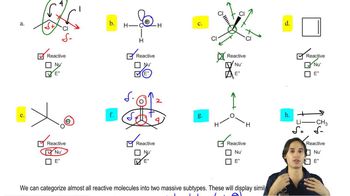
Nucleophiles are species that donate an electron pair to form a chemical bond, while electrophiles are electron-deficient species that accept an electron pair. Identifying these species in a reaction is essential for proposing a mechanism, as it helps to determine the direction of electron flow and the nature of the reaction intermediates.
Video consigliato:
03:
Nucleophile or Electrophile

Transition States and Intermediates

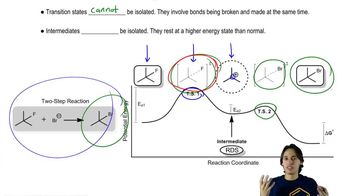
Transition states are high-energy states that occur during the transformation of reactants to products, representing the point of maximum energy along the reaction pathway. Intermediates are species that are formed and consumed during the reaction but are not present in the final products. Understanding these concepts is vital for accurately depicting the mechanism and predicting the reaction's rate and outcome.
Video consigliato:
06:55
Intermediates vs. Transition States