Ch. 8 - Delocalized Electrons: Their Effect on Stability, pKa, and the Products of a Reaction • Aromaticity and Electronic Effects: An Introduction to the Reactions of Benzene
Bruice - Organic Chemistry 8th Edition
Bruice8th EditionOrganic ChemistryISBN: 9780135213711Non è quello che usi tu?Cambia libro di testo
Capitolo 8, Problema 32b

What are the products of the following reactions, assuming that one equivalent of each reagent is used in each reaction? Disregard stereoisomers.
b. Chemical structure showing a conjugated diene reacting with HBr, indicating potential products of 1,2 and 1,4 addition.

Guida verificata passo dopo passo
1
Step 1: Analyze the structure of the starting compound. The molecule contains two double bonds, which are conjugated (alternating single and double bonds). This conjugation stabilizes the molecule and affects the reactivity of the double bonds.
Step 2: Recognize the reagent used in the reaction. HBr (hydrobromic acid) is a strong acid that adds across double bonds in an electrophilic addition reaction. Since only one equivalent of HBr is used, it will react with one of the double bonds.
Step 3: Determine the regioselectivity of the reaction. The addition of HBr follows Markovnikov's rule, where the hydrogen atom adds to the carbon of the double bond that already has more hydrogen atoms, and the bromine atom adds to the carbon with fewer hydrogen atoms.
Step 4: Identify the most reactive double bond. In conjugated systems, the double bond closer to the alkyl substituent (more substituted) is typically more reactive due to stabilization of the carbocation intermediate formed during the reaction.
Step 5: Predict the product. The HBr will add across the more reactive double bond, resulting in the formation of a brominated alkene. The remaining double bond will stay intact, and stereoisomers are disregarded as per the problem statement.

Risposta video verificata per un problema simile:

Questa soluzione video è stata consigliata dai nostri tutor come utile per risolvere questo problema.
Durata del video:
6m

Concetti chiave

Ecco i concetti essenziali che devi comprendere per rispondere correttamente alla domanda.

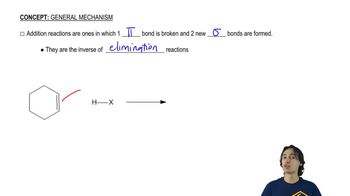
Electrophilic Addition Reactions

Electrophilic addition reactions involve the addition of an electrophile to a nucleophile, typically across a double bond. In this case, HBr acts as the electrophile, where the hydrogen atom adds to one carbon of the double bond and the bromine adds to the other. Understanding this mechanism is crucial for predicting the products formed in the reaction.
Video consigliato:
05:39
Features of Addition Mechanisms.

Markovnikov's Rule

Markovnikov's Rule states that in the addition of HX to an alkene, the hydrogen atom will attach to the carbon with the greater number of hydrogen atoms already attached, while the halide (Br in this case) will attach to the carbon with fewer hydrogen atoms. This rule helps in determining the regioselectivity of the product formed during the reaction.
Video consigliato:
03:54
The 18 and 16 Electron Rule

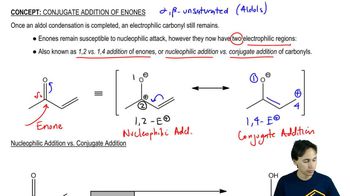
1,2 vs 1,4 Addition

In conjugated systems, electrophilic addition can occur at different positions, leading to 1,2 or 1,4 addition products. The 1,2 addition occurs when the electrophile adds to adjacent carbons, while 1,4 addition involves the electrophile adding to carbons that are separated by one carbon. Recognizing these pathways is essential for predicting the major products in reactions involving conjugated systems.
Video consigliato:
09:23
1,2 vs 1,4 Addition