Ch. 8 - Delocalized Electrons: Their Effect on Stability, pKa, and the Products of a Reaction • Aromaticity and Electronic Effects: An Introduction to the Reactions of Benzene
Bruice - Organic Chemistry 8th Edition
Bruice8th EditionOrganic ChemistryISBN: 9780135213711Non è quello che usi tu?Cambia libro di testo
Capitolo 8, Problema 42b

What two products are formed from each of the following reactions?
b. Chemical reaction showing two reactants with structural formulas leading to products in a Diels-Alder reaction.

Guida verificata passo dopo passo
1
Identify the type of reaction taking place (e.g., substitution, elimination, addition, etc.) by analyzing the reactants and reaction conditions provided in the problem.
Determine the structure of the starting material and identify the functional groups or reactive sites that will participate in the reaction.
Apply the reaction mechanism to predict the intermediates and the rearrangements, if any, that occur during the reaction. For example, in an elimination reaction, consider the formation of a carbocation intermediate and the removal of a leaving group.
Predict the major and minor products based on the reaction mechanism and the stability of the intermediates. For example, in elimination reactions, the Zaitsev rule often applies, favoring the formation of the more substituted alkene.
Draw the structures of the two products formed, ensuring that stereochemistry (if applicable) is correctly represented in the final products.

Risposta video verificata per un problema simile:

Questa soluzione video è stata consigliata dai nostri tutor come utile per risolvere questo problema.
Durata del video:
3m

Concetti chiave

Ecco i concetti essenziali che devi comprendere per rispondere correttamente alla domanda.

Reaction Mechanisms

Understanding reaction mechanisms is crucial in organic chemistry as they describe the step-by-step process by which reactants transform into products. This includes identifying intermediates, transition states, and the types of bonds that are formed or broken during the reaction. Familiarity with mechanisms helps predict the products of a reaction based on the reactants involved.
Video consigliato:
02:16
Heck Reaction Mechanism

Functional Groups

Functional groups are specific groups of atoms within molecules that are responsible for the characteristic chemical reactions of those molecules. Recognizing functional groups allows chemists to predict the behavior of organic compounds during reactions. For example, alcohols, carboxylic acids, and amines each have distinct reactivity patterns that influence the products formed in chemical reactions.
Video consigliato:
02:36
Identifying Functional Groups

Stoichiometry

Stoichiometry involves the calculation of reactants and products in chemical reactions based on the conservation of mass. It allows chemists to determine the proportions of substances consumed and produced in a reaction. Understanding stoichiometry is essential for predicting the amounts of products formed from given reactants, which is particularly important in multi-step reactions.
Video consigliato:
02:08
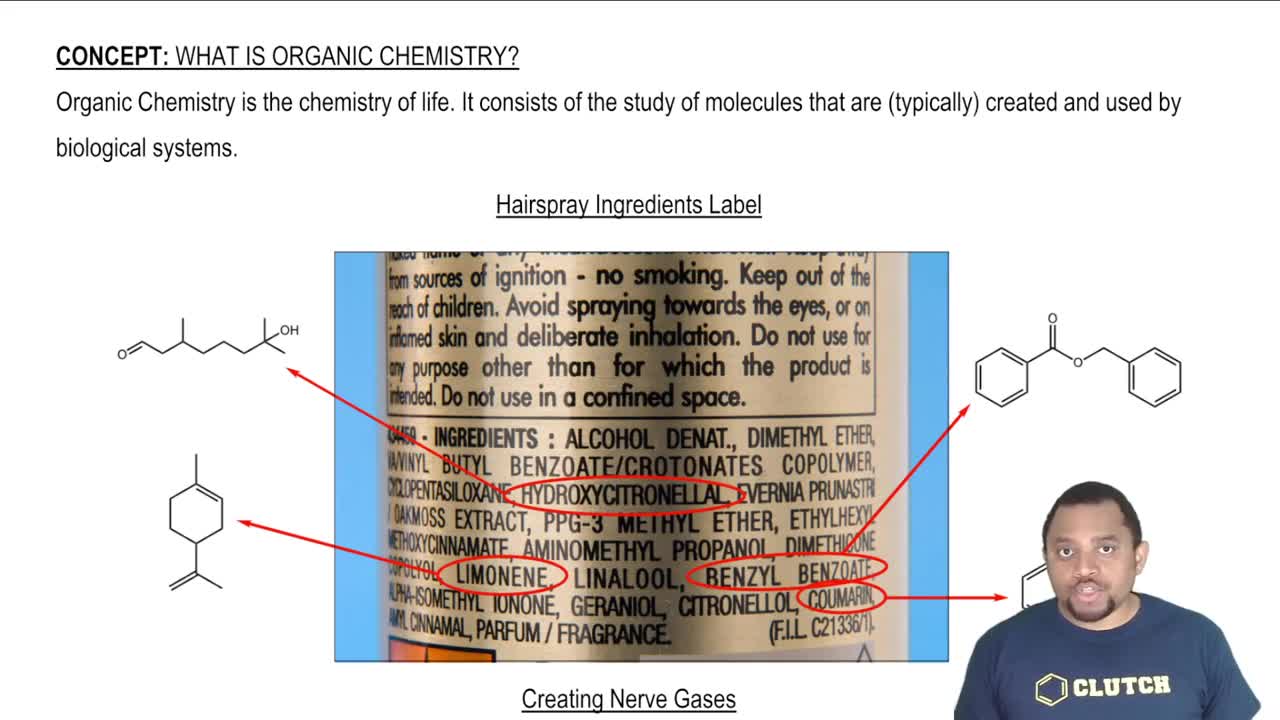
Organic molecules in your everyday life.