Ch. 9 - Substitution and Elimination Reactions of Alkyl Halides
Bruice - Organic Chemistry 8th Edition
Bruice8th EditionOrganic ChemistryISBN: 9780135213711Non è quello che usi tu?Cambia libro di testo
Capitolo 9, Problema 102

cis-1-Bromo-4-tert-butylcyclohexane and trans-1-bromo-4-tert-butylcyclohexane both react with sodium ethoxide in ethanol to form 4-tert-butylcyclohexene. Explain why the cis isomer reacts much more rapidly than the trans isomer.

Guida verificata passo dopo passo
1
Analyze the structure of cis-1-bromo-4-tert-butylcyclohexane and trans-1-bromo-4-tert-butylcyclohexane. In both cases, the cyclohexane ring adopts a chair conformation, and the bulky tert-butyl group will preferentially occupy the equatorial position to minimize steric strain.
In the cis isomer, the bromine atom is in the axial position when the tert-butyl group is equatorial. This arrangement allows for a favorable anti-periplanar geometry between the β-hydrogen (on the adjacent carbon) and the leaving group (bromine), which is a requirement for the E2 elimination mechanism.
In the trans isomer, the bromine atom is in the equatorial position when the tert-butyl group is equatorial. This arrangement does not provide the necessary anti-periplanar geometry between the β-hydrogen and the leaving group, making the E2 elimination less favorable.
The anti-periplanar geometry is critical for the E2 mechanism because it allows for the proper orbital alignment for the base (sodium ethoxide) to abstract the β-hydrogen and for the leaving group (bromine) to depart simultaneously, forming the double bond.
As a result, the cis isomer reacts much more rapidly than the trans isomer because the anti-periplanar geometry is readily available in the cis isomer, facilitating the elimination reaction to form 4-tert-butylcyclohexene.

Risposta video verificata per un problema simile:

Questa soluzione video è stata consigliata dai nostri tutor come utile per risolvere questo problema.
Durata del video:
7m

Concetti chiave

Ecco i concetti essenziali che devi comprendere per rispondere correttamente alla domanda.

Steric Hindrance

Steric hindrance refers to the repulsion between atoms that occurs when they are brought close together, which can affect the reactivity of molecules. In the case of cis-1-bromo-4-tert-butylcyclohexane, the bulky tert-butyl group is positioned on the same side as the bromine atom, allowing for a more favorable transition state during the reaction. In contrast, the trans isomer has the tert-butyl group on the opposite side, leading to increased steric hindrance and a less favorable reaction pathway.
Video consigliato:
02:53
Understanding steric effects.

E2 Elimination Mechanism

The E2 elimination mechanism involves the simultaneous removal of a leaving group and a hydrogen atom from adjacent carbon atoms, resulting in the formation of a double bond. For the cis isomer, the spatial arrangement allows for the necessary anti-periplanar orientation of the leaving bromine and the hydrogen atom, facilitating a faster reaction. The trans isomer, however, may not achieve this optimal orientation as easily, leading to a slower reaction rate.
Video consigliato:
09:36
Drawing the E2 Mechanism.

Conformational Analysis

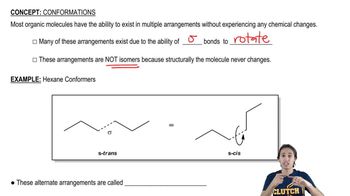
Conformational analysis studies the different spatial arrangements of a molecule that can occur due to rotation around single bonds. In cyclohexane derivatives, the chair conformation is the most stable, but the positioning of substituents can significantly influence reactivity. The cis isomer can adopt a conformation that minimizes steric strain and maximizes the accessibility of the bromine for elimination, while the trans isomer may have a less favorable conformation, contributing to its slower reaction rate.
Video consigliato:
03:29
Understanding what a conformer is.