Would you expect acetate ion (CH3CO2−) to be a better nucleophile in an SN2 reaction with an alkyl halide carried out in methanol or in dimethyl sulfoxide?
Ch. 9 - Substitution and Elimination Reactions of Alkyl Halides
Tutti i libri di testo
Bruice 8th Edition
Ch. 9 - Substitution and Elimination Reactions of Alkyl Halides
Problema 56d,e
Bruice 8th Edition
Ch. 9 - Substitution and Elimination Reactions of Alkyl Halides
Problema 56d,eCapitolo 9, Problema 56d,e
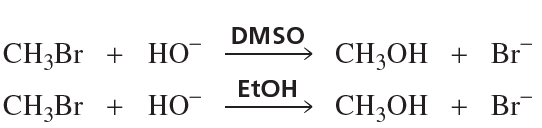
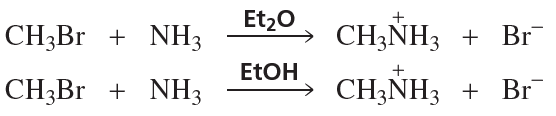
Which reaction in each of the following pairs takes place more rapidly? (EtOH is ethyl alcohol; Et2O is diethyl ether.)
d. 
e. 
Guida verificata passo dopo passo1
Step 1: Analyze the reaction mechanism for each pair of reactions. For part (d), consider the nucleophilic substitution reactions (SN2 or SN1) and the solvent effects. DMSO is a polar aprotic solvent, which favors SN2 reactions by stabilizing the transition state without solvating the nucleophile. EtOH, on the other hand, is a polar protic solvent, which can solvate the nucleophile and slow down SN2 reactions.
Step 2: Compare the nucleophiles in part (d). HO⁻ is a strong nucleophile, and its reactivity will be influenced by the solvent. In DMSO, HO⁻ remains highly reactive, while in EtOH, its reactivity is reduced due to solvation. This suggests that the reaction in DMSO will proceed more rapidly.
Step 3: For part (e), examine the reaction between CH3Br and NH3. NH3 acts as a nucleophile, and the solvent plays a role in determining the reaction rate. Et2O is a nonpolar solvent, which does not significantly stabilize the transition state or solvate the nucleophile. EtOH, being polar protic, can solvate NH3 and reduce its nucleophilicity.
Step 4: Consider the steric and electronic effects in part (e). CH3Br is a methyl halide, which is highly reactive in SN2 reactions due to minimal steric hindrance. The solvent choice (Et2O vs. EtOH) will influence the nucleophilicity of NH3 and the overall reaction rate.
Step 5: Summarize the findings. For part (d), the reaction in DMSO is expected to be faster due to the polar aprotic nature of the solvent favoring SN2. For part (e), the reaction in Et2O is likely faster because the nonpolar solvent does not solvate NH3, allowing it to remain more nucleophilic compared to EtOH.

Risposta video verificata per un problema simile:
Questa soluzione video è stata consigliata dai nostri tutor come utile per risolvere questo problema.
Durata del video:
1mConcetti chiave
Ecco i concetti essenziali che devi comprendere per rispondere correttamente alla domanda.
Nucleophilic Substitution Reactions
Nucleophilic substitution reactions involve the replacement of a leaving group in a molecule by a nucleophile. The rate of these reactions can depend on the strength of the nucleophile, the nature of the leaving group, and the solvent used. In the context of the question, understanding how nucleophiles like HO− and NH3 interact with CH3Br is crucial for predicting which reaction will occur more rapidly.
Video consigliato:
Nucleophiles and Electrophiles can react in Substitution Reactions.
Solvent Effects on Reaction Rates
The choice of solvent can significantly influence the rate of chemical reactions, particularly in nucleophilic substitutions. Polar protic solvents, like ethanol (EtOH), can stabilize ions and transition states, while polar aprotic solvents, like DMSO, can enhance nucleophilicity. Recognizing how the solvent affects the reactivity of the nucleophile and the leaving group is essential for determining the faster reaction in the pairs presented.
Video consigliato:
Percorso guidato
Rates of Intramolecular Reactions Concept 2
Leaving Group Ability
The ability of a leaving group to depart from a molecule is a key factor in determining the rate of nucleophilic substitution reactions. Good leaving groups, such as bromide (Br−), can stabilize the transition state and facilitate the reaction. In the question, comparing the reactions involving CH3Br with different nucleophiles and solvents requires an understanding of how the leaving group's characteristics influence the overall reaction kinetics.
Video consigliato:
How to use the factors affecting acidity to predict leaving group ability.
Pratica correlata
Domanda del libro di testo
1376
views
Domanda del libro di testo
Under which of the following reaction conditions will (R)-1-chloro-1-phenylethane form the most (R)-1-phenyl-1-ethanol: in water or in 1.0 M HO−?
590
views
Domanda del libro di testo
How will the rate of each of the following SN2 reactions change if it is carried out in a more polar solvent?
b.
1028
views
Domanda del libro di testo
How will the rate of each of the following SN2 reactions change if it is carried out in a more polar solvent?
c.
1425
views
Domanda del libro di testo
What is the best way to prepare the following ethers using an alkyl halide and an alkoxide ion?
a.
b.
1507
views
Domanda del libro di testo
Which reaction in each of the following pairs takes place more rapidly? (EtOH is ethyl alcohol; Et2O is diethyl ether.)
a.
b.
c.
1186
views
1
rank