Ch. 10 - Alkynes: Electrophilic Addition and Redox Reactions
Mullins - Organic Chemistry: A Learner Centered Approach 1st Edition
Mullins1st EditionOrganic Chemistry: A Learner Centered ApproachISBN: 9780137566471Non è quello che usi tu?Cambia libro di testo
Capitolo 9, Problema 38

Draw the ketone(s) you would expect to form by treating the following alkynes under the conditions of hydroboration–oxidation: (a) 6-methyloct-1-yne, (b) 1,10-dicyclohexyldec-5-yne, and (c) 5-phenylhex-2-yne.
<IMAGE>

Guida verificata passo dopo passo
1
Step 1: Understand the reaction mechanism. Hydroboration–oxidation of alkynes involves the addition of borane (BH₃) to the triple bond, followed by oxidation with hydrogen peroxide (H₂O₂) in the presence of sodium hydroxide (NaOH). This reaction converts the alkyne into a ketone via anti-Markovnikov addition.
Step 2: Analyze the structure of the alkyne. For each alkyne provided, identify the triple bond and determine the regioselectivity of the reaction. Hydroboration–oxidation typically results in the formation of a ketone at the less substituted carbon of the triple bond.
Step 3: For (a) 6-methyloct-1-yne, locate the triple bond between carbons 1 and 2. The hydroboration–oxidation will yield a ketone at the terminal carbon (C1), as it is less substituted. Draw the resulting ketone structure.
Step 4: For (b) 1,10-dicyclohexyldec-5-yne, locate the triple bond between carbons 5 and 6. The hydroboration–oxidation will yield a ketone at carbon 5, as it is less substituted compared to carbon 6. Draw the resulting ketone structure.
Step 5: For (c) 5-phenylhex-2-yne, locate the triple bond between carbons 2 and 3. The hydroboration–oxidation will yield a ketone at carbon 2, as it is less substituted compared to carbon 3. Draw the resulting ketone structure.

Risposta video verificata per un problema simile:

Questa soluzione video è stata consigliata dai nostri tutor come utile per risolvere questo problema.
Durata del video:
6m

Concetti chiave

Ecco i concetti essenziali che devi comprendere per rispondere correttamente alla domanda.

Hydroboration-Oxidation

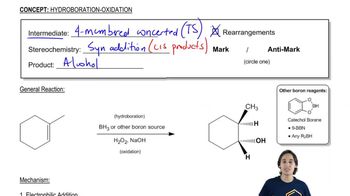
Hydroboration-oxidation is a two-step reaction process used to convert alkynes into carbonyl compounds, specifically ketones or aldehydes. In the first step, borane (BH₃) adds across the triple bond of the alkyne, forming a trialkylborane intermediate. The second step involves oxidation with hydrogen peroxide (H₂O₂) and a base (NaOH), which converts the boron atom into a hydroxyl group, yielding the corresponding ketone or aldehyde.
Video consigliato:
06:38
General properties of hydroboration-oxidation.

Alkyne Reactivity

Alkynes are hydrocarbons containing a carbon-carbon triple bond, which makes them highly reactive. Their reactivity allows them to undergo various addition reactions, including hydroboration. The position of the triple bond and the substituents on the alkyne influence the regioselectivity of the reaction, determining whether a ketone or aldehyde is formed after oxidation.
Video consigliato:
09:11
Alkyne Hydration

Regioselectivity

Regioselectivity refers to the preference of a chemical reaction to yield one structural isomer over others when multiple products are possible. In the context of hydroboration-oxidation of alkynes, the regioselectivity is influenced by the sterics and electronics of the substituents on the alkyne. This concept is crucial for predicting the specific ketone products formed from the given alkynes in the question.
Video consigliato:
05:09
Heck Reaction