Ch. 10 - Alkynes: Electrophilic Addition and Redox Reactions
Mullins - Organic Chemistry: A Learner Centered Approach 1st Edition
Mullins1st EditionOrganic Chemistry: A Learner Centered ApproachISBN: 9780137566471Non è quello che usi tu?Cambia libro di testo
Capitolo 9, Problema 45b

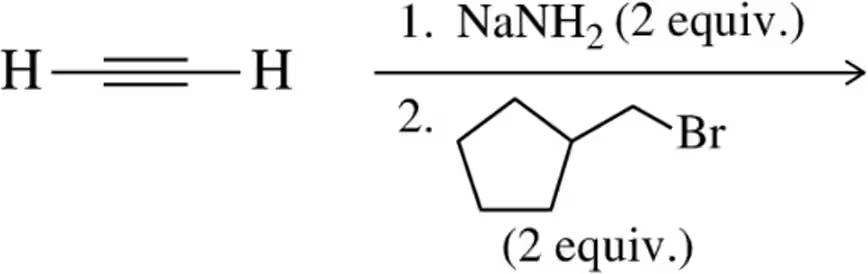
Show the products of the following acetylide alkylation reactions. [Make sure your product has the correct number of carbons.]
(b) Acetylide alkylation reaction showing reactants and products with specified reagents and conditions.

Guida verificata passo dopo passo
1
Step 1: Recognize that the reaction involves acetylide alkylation. The starting material is acetylene (H-C≡C-H), which will undergo deprotonation to form an acetylide ion.
Step 2: The first reagent, NaNH₂ (2 equivalents), is a strong base that will deprotonate both hydrogens on the acetylene molecule, forming the acetylide ion (C≡C²⁻). This ion is highly nucleophilic.
Step 3: The second reagent, bromocyclopentane (2 equivalents), is an alkyl halide. The acetylide ion will attack the carbon attached to the bromine in an SN2 reaction, displacing the bromine and forming a new carbon-carbon bond.
Step 4: Since 2 equivalents of bromocyclopentane are used, the acetylide ion will react twice, adding two cyclopentyl groups to the acetylene molecule. This results in a product with two cyclopentyl groups attached to the original triple bond.
Step 5: Verify the final product structure by ensuring the correct number of carbons and connectivity. The product will have a total of 12 carbons: 2 from the acetylene and 10 from the two cyclopentyl groups.

Risposta video verificata per un problema simile:

Questa soluzione video è stata consigliata dai nostri tutor come utile per risolvere questo problema.

Concetti chiave

Ecco i concetti essenziali che devi comprendere per rispondere correttamente alla domanda.

Acetylide Ion Formation

Acetylide ions are formed by deprotonating terminal alkynes using strong bases like sodium amide (NaNH2). This reaction generates a nucleophilic acetylide ion, which can then participate in nucleophilic substitution reactions with alkyl halides, allowing for the formation of longer carbon chains.
Video consigliato:
Percorso guidato
3:39
Metal Ion Catalysis Concept 1

Nucleophilic Substitution Reactions

Nucleophilic substitution reactions involve the replacement of a leaving group (like bromine in the provided reaction) by a nucleophile (the acetylide ion). The mechanism can follow either an SN2 pathway, where the nucleophile attacks the electrophile directly, or an SN1 pathway, which involves the formation of a carbocation intermediate. The choice of mechanism depends on the structure of the substrate and the conditions of the reaction.
Video consigliato:
01:47
Nucleophiles and Electrophiles can react in Substitution Reactions.

Carbon Count in Organic Synthesis

In organic synthesis, it is crucial to account for the number of carbon atoms in the products. The reaction of an acetylide ion with an alkyl halide adds the carbon chain of the halide to the acetylide, thus increasing the total carbon count. Ensuring the correct number of carbons in the final product is essential for maintaining the integrity of the molecular structure and for further synthetic applications.
Video consigliato:
07:07
Electron Counting