


Ch. 11 - Properties and Synthesis of Alkyl Halides: Radical Reactions
Mullins - Organic Chemistry: A Learner Centered Approach 1st Edition
Mullins1st EditionOrganic Chemistry: A Learner Centered ApproachISBN: 9780137566471Non è quello che usi tu?Cambia libro di testo
Capitolo 10, Problema 62b

A halogenation intended to make compound A formed B instead.

(b) Suggest a mechanism that rationalizes the formation of B.

Guida verificata passo dopo passo
1
Identify the starting compound and the intended product. The starting compound is an alkylbenzene with two different hydrogen atoms labeled Ha and Hb. The intended product A is the bromination at the position of Ha.
Recognize the actual product formed, which is compound B. This indicates that bromination occurred at the position of Hb instead of Ha.
Consider the mechanism of radical halogenation. In the presence of Br2 and heat, a radical chain reaction is initiated. The first step involves the homolytic cleavage of Br2 to form two bromine radicals.
Analyze the stability of the radicals formed by abstraction of Ha and Hb. The radical formed by abstraction of Hb is more stable due to hyperconjugation and possibly resonance stabilization with the benzene ring, making it the preferred site for bromination.
Propose the mechanism: The bromine radical abstracts the hydrogen atom Hb, forming a more stable secondary radical. This radical then reacts with another Br2 molecule to form the brominated product B, completing the radical chain reaction.

Risposta video verificata per un problema simile:

Questa soluzione video è stata consigliata dai nostri tutor come utile per risolvere questo problema.
Durata del video:
4m

Concetti chiave

Ecco i concetti essenziali che devi comprendere per rispondere correttamente alla domanda.

Halogenation

Halogenation is a chemical reaction that involves the addition of halogen atoms (such as chlorine or bromine) to a compound. This process can occur through various mechanisms, including electrophilic addition or radical substitution, depending on the nature of the substrate and reaction conditions. Understanding halogenation is crucial for predicting the products formed when halogens react with organic compounds.
Video consigliato:
03:45
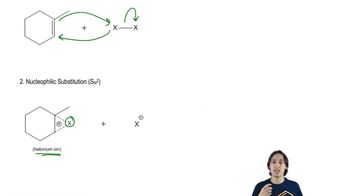
Halogenation Mechanism

Reaction Mechanism

A reaction mechanism is a step-by-step description of the pathway by which reactants transform into products during a chemical reaction. It includes details about the intermediates formed, the transition states, and the energy changes involved. Proposing a mechanism for the formation of compound B from A requires knowledge of the specific steps and conditions that lead to the observed product.
Video consigliato:
02:16
Heck Reaction Mechanism

Regioselectivity

Regioselectivity refers to the preference of a chemical reaction to occur at one location over another in a molecule, leading to the formation of specific isomers. In halogenation reactions, regioselectivity can significantly influence the outcome, as the halogen may add to different positions on the substrate. Understanding regioselectivity is essential for rationalizing why compound B was formed instead of the expected compound A.
Video consigliato:
05:09
Heck Reaction