Ch. 11 - Properties and Synthesis of Alkyl Halides: Radical Reactions
Mullins - Organic Chemistry: A Learner Centered Approach 1st Edition
Mullins1st EditionOrganic Chemistry: A Learner Centered ApproachISBN: 9780137566471Non è quello che usi tu?Cambia libro di testo
Capitolo 10, Problema 25a

Predict the major products of the following alkene halogenation reactions. [D is the symbol for deuterium, an isotope of hydrogen.]
(a)

Guida verificata passo dopo passo
1
Identify the type of reaction: The reaction involves an alkene and HBr in the presence of H2O2, which indicates a radical addition reaction.
Understand the mechanism: In the presence of peroxides (H2O2), HBr adds to alkenes via a radical mechanism, leading to anti-Markovnikov addition.
Determine the regioselectivity: In anti-Markovnikov addition, the bromine atom will add to the less substituted carbon of the double bond.
Analyze the structure: The alkene shown is 2-methyl-2-butene. The double bond is between the second and third carbon atoms.
Predict the major product: The bromine will add to the terminal carbon (carbon 3), and the hydrogen will add to the more substituted carbon (carbon 2), resulting in the formation of 2-bromo-2-methylbutane.

Risposta video verificata per un problema simile:

Questa soluzione video è stata consigliata dai nostri tutor come utile per risolvere questo problema.

Concetti chiave

Ecco i concetti essenziali che devi comprendere per rispondere correttamente alla domanda.

Alkene Reactivity

Alkenes are unsaturated hydrocarbons characterized by at least one carbon-carbon double bond. This double bond is a site of high reactivity, allowing alkenes to undergo various addition reactions, such as halogenation. In these reactions, halogens (like Cl2 or Br2) add across the double bond, resulting in the formation of vicinal dihalides.
Video consigliato:
Percorso guidato
2:09
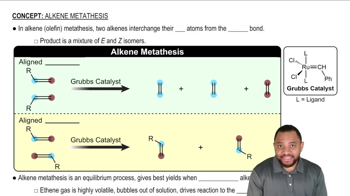
Alkene Metathesis Concept 1

Markovnikov's Rule

Markovnikov's Rule states that in the addition of HX (where X is a halogen) to an alkene, the hydrogen atom will attach to the carbon with the greater number of hydrogen atoms already attached. This principle helps predict the major product of the reaction, as it favors the formation of the more stable carbocation intermediate during the reaction process.
Video consigliato:
03:54
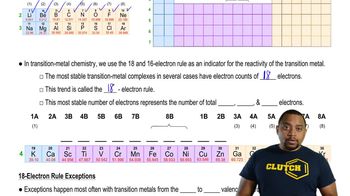
The 18 and 16 Electron Rule

Stereochemistry of Halogenation

Halogenation of alkenes can lead to stereochemical outcomes, including the formation of enantiomers or diastereomers. The addition of halogens typically occurs in a trans fashion, resulting in anti-addition products. Understanding the stereochemical implications is crucial for predicting the specific isomers formed in the reaction.
Video consigliato:
Percorso guidato
1:38
Polymer Stereochemistry Concept 1