Ch. 11 - Properties and Synthesis of Alkyl Halides: Radical Reactions
Mullins - Organic Chemistry: A Learner Centered Approach 1st Edition
Mullins1st EditionOrganic Chemistry: A Learner Centered ApproachISBN: 9780137566471Non è quello che usi tu?Cambia libro di testo
Capitolo 10, Problema 32c

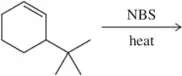
Predict the products of the following allylic halogenation reactions.
(c) Chemical reaction diagram showing cyclohexene with tert-butyl group reacting with NBS under heat conditions.

Guida verificata passo dopo passo
1
Identify the allylic position in the given molecule. The allylic position is the carbon atom adjacent to a carbon-carbon double bond.
Determine the halogen used in the reaction. Allylic halogenation typically involves chlorine (Cl2) or bromine (Br2) in the presence of a radical initiator like N-bromosuccinimide (NBS) for bromination.
Understand the mechanism: Allylic halogenation proceeds via a radical mechanism. The reaction begins with the formation of a radical at the allylic position.
Consider resonance stabilization: The allylic radical can be stabilized by resonance, which means the radical can be delocalized over the π system. Draw all possible resonance structures to identify potential sites for halogenation.
Predict the products: The halogen will add to the allylic position, and due to resonance, multiple products may form. Identify all possible products by considering each resonance structure and where the halogen can add.

Risposta video verificata per un problema simile:

Questa soluzione video è stata consigliata dai nostri tutor come utile per risolvere questo problema.
Durata del video:
5m

Concetti chiave

Ecco i concetti essenziali che devi comprendere per rispondere correttamente alla domanda.

Allylic Halogenation

Allylic halogenation is a reaction where a halogen atom is introduced at the allylic position of an alkene. This position is adjacent to the double bond, and the reaction typically involves the use of N-bromosuccinimide (NBS) in the presence of light or heat to generate radicals. The process is selective for the allylic position due to the stability of the allylic radical intermediate.
Video consigliato:
06:15
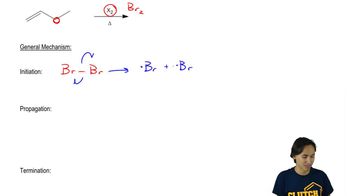
The general mechanism of Allylic Halogenation.

Radical Mechanism

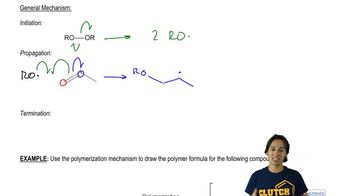
The radical mechanism is a chain reaction involving initiation, propagation, and termination steps. In allylic halogenation, the initiation step generates radicals, often through the homolytic cleavage of a halogen molecule. Propagation involves the abstraction of a hydrogen atom from the allylic position, forming a stable allylic radical, which then reacts with a halogen molecule to form the halogenated product and regenerate the radical.
Video consigliato:
03:28
The mechanism of Radical Polymerization.

Stability of Allylic Radicals

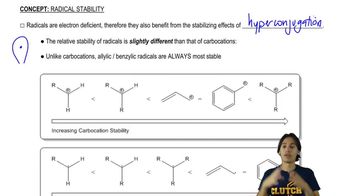
Allylic radicals are more stable than typical alkyl radicals due to resonance stabilization. The unpaired electron in an allylic radical can be delocalized over the π system of the adjacent double bond, distributing the radical character over multiple atoms. This delocalization lowers the energy of the radical, making allylic positions more reactive in radical halogenation reactions.
Video consigliato:
03:43
The radical stability trend.