Ch. 11 - Properties and Synthesis of Alkyl Halides: Radical Reactions
Mullins - Organic Chemistry: A Learner Centered Approach 1st Edition
Mullins1st EditionOrganic Chemistry: A Learner Centered ApproachISBN: 9780137566471Non è quello che usi tu?Cambia libro di testo
Capitolo 10, Problema 14

Provide a mechanism for the chlorination of cyclohexane. Be sure to include initiation, propagation, and three possible termination steps.

Guida verificata passo dopo passo
1
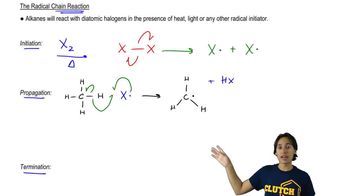
Initiation: The chlorination of cyclohexane begins with the homolytic cleavage of the chlorine molecule (Cl₂) under the influence of heat or light. This results in the formation of two chlorine radicals. The reaction can be represented as: Cl₂ → 2Cl•.
Propagation Step 1: A chlorine radical abstracts a hydrogen atom from cyclohexane, forming hydrochloric acid (HCl) and a cyclohexyl radical. This step can be represented as: Cl• + C₆H₁₂ → HCl + C₆H₁₁•.
Propagation Step 2: The cyclohexyl radical reacts with another chlorine molecule to form chlorocyclohexane and regenerate a chlorine radical. This step can be represented as: C₆H₁₁• + Cl₂ → C₆H₁₁Cl + Cl•.
Termination Step 1: Two chlorine radicals can combine to form chlorine gas, effectively removing radicals from the reaction mixture. This step can be represented as: Cl• + Cl• → Cl₂.
Termination Step 2: A cyclohexyl radical can combine with a chlorine radical to form chlorocyclohexane, terminating the radical chain. This step can be represented as: C₆H₁₁• + Cl• → C₆H₁₁Cl.

Risposta video verificata per un problema simile:

Questa soluzione video è stata consigliata dai nostri tutor come utile per risolvere questo problema.
Durata del video:
7m

Concetti chiave

Ecco i concetti essenziali che devi comprendere per rispondere correttamente alla domanda.

Free Radical Halogenation

Free radical halogenation is a reaction mechanism where halogens, such as chlorine, react with alkanes to form alkyl halides. This process involves the generation of free radicals, which are highly reactive species with unpaired electrons. The mechanism consists of three main stages: initiation, propagation, and termination, each playing a crucial role in the overall reaction.
Video consigliato:
12:11
Radical Chain Reaction Mechanism.

Initiation Step

The initiation step involves the formation of free radicals, typically through the homolytic cleavage of a chlorine molecule (Cl2) under heat or light. This generates two chlorine radicals, which are essential for starting the chlorination process. The presence of these radicals sets the stage for the subsequent propagation steps, where they will react with cyclohexane.
Video consigliato:
Percorso guidato
1:05
Step-Growth Polymers Concept 1

Propagation and Termination Steps

Propagation steps involve the reaction of chlorine radicals with cyclohexane to form alkyl radicals, which can further react with chlorine molecules to produce alkyl halides and regenerate chlorine radicals. Termination steps occur when two radicals combine to form a stable product, effectively stopping the chain reaction. These steps are crucial for controlling the reaction and determining the final products.
Video consigliato:
Percorso guidato
1:05
Step-Growth Polymers Concept 1