Ch. 11 - Properties and Synthesis of Alkyl Halides: Radical Reactions
Mullins - Organic Chemistry: A Learner Centered Approach 1st Edition
Mullins1st EditionOrganic Chemistry: A Learner Centered ApproachISBN: 9780137566471Non è quello che usi tu?Cambia libro di testo
Capitolo 10, Problema 18b

Using the bond-dissociation energies in Table 5.6,
(b) Will the transition state be reactant-like or product-like? Explain your answer.

Guida verificata passo dopo passo
1
Step 1: Understand the Hammond Postulate, which states that the structure of the transition state resembles the structure (reactants or products) that it is closer to in energy. This is key to determining whether the transition state is reactant-like or product-like.
Step 2: Analyze the bond-dissociation energies (BDEs) provided in the table. Bond-dissociation energy is the energy required to break a bond into two fragments. Compare the BDEs of the bonds being broken and formed in the reaction to assess the energy difference between reactants and products.
Step 3: If the reaction is exothermic (products are lower in energy than reactants), the transition state will be closer in structure to the reactants. Conversely, if the reaction is endothermic (products are higher in energy than reactants), the transition state will resemble the products.
Step 4: Identify the specific bonds involved in the reaction (e.g., bonds being broken and formed). Use the BDE values from the table to calculate the overall energy change for the reaction. This will help determine whether the reaction is exothermic or endothermic.
Step 5: Based on the energy change and the Hammond Postulate, conclude whether the transition state is reactant-like or product-like. Provide reasoning based on the energy proximity of the transition state to either reactants or products.

Risposta video verificata per un problema simile:

Questa soluzione video è stata consigliata dai nostri tutor come utile per risolvere questo problema.
Durata del video:
5m

Concetti chiave

Ecco i concetti essenziali che devi comprendere per rispondere correttamente alla domanda.

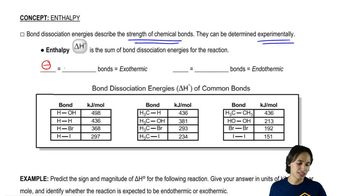
Bond-Dissociation Energy

Bond-dissociation energy is the energy required to break a specific bond in a molecule, resulting in the formation of two radicals. It is a crucial concept in understanding the stability of reactants and products in a chemical reaction. Higher bond-dissociation energies indicate stronger bonds, which can influence the transition state of a reaction.
Video consigliato:
04:09
How to calculate enthalpy using bond dissociation energies.

Transition State

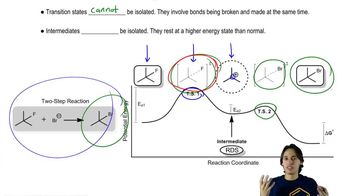
The transition state is a high-energy, unstable arrangement of atoms that occurs during the transformation from reactants to products. It represents the point of maximum energy along the reaction pathway and is critical for determining the reaction's rate and mechanism. Understanding whether the transition state is more similar to the reactants or products helps predict the reaction's favorability.
Video consigliato:
06:55
Intermediates vs. Transition States

Reactant-like vs. Product-like Transition States

A transition state is considered reactant-like if it resembles the structure of the reactants more than the products, typically occurring when the energy barrier to form products is high. Conversely, a product-like transition state resembles the products and indicates a lower energy barrier. Analyzing bond-dissociation energies can help determine the nature of the transition state and its implications for reaction kinetics.
Video consigliato:
01:47
Understanding “like dissolves like”.