Ch. 12 - Substitution and Elimination: Reactions of Haloalkanes
Mullins - Organic Chemistry: A Learner Centered Approach 1st Edition
Mullins1st EditionOrganic Chemistry: A Learner Centered ApproachISBN: 9780137566471Non è quello che usi tu?Cambia libro di testo
Capitolo 11, Problema 66b

Give a mechanism for the following substitution and elimination reactions.
(b)

Guida verificata passo dopo passo
1
Step 1: Analyze the reactants and products. The reactant is a tertiary alkyl bromide, and the product is an alkene. The reaction involves elimination, likely an E2 mechanism due to the presence of a strong base (ethanol).
Step 2: Identify the base and its role. Ethanol (CH3CH2OH) acts as a nucleophile and base, facilitating the elimination of the bromide group and a proton from a β-carbon.
Step 3: Determine the β-hydrogens available for elimination. The tertiary carbon bonded to bromine has adjacent β-carbons with hydrogens that can be abstracted by the base.
Step 4: Describe the elimination mechanism. The base abstracts a β-hydrogen, forming a double bond between the α-carbon (attached to bromine) and the β-carbon. Simultaneously, the bromide ion leaves as a leaving group.
Step 5: Confirm the product formation. The major product is the more substituted alkene (Zaitsev's rule), which is the one shown in the image. This occurs because the elimination favors the formation of the more stable alkene.

Risposta video verificata per un problema simile:

Questa soluzione video è stata consigliata dai nostri tutor come utile per risolvere questo problema.

Concetti chiave

Ecco i concetti essenziali che devi comprendere per rispondere correttamente alla domanda.

Nucleophilic Substitution Mechanisms

Nucleophilic substitution reactions involve the replacement of a leaving group by a nucleophile. The two primary mechanisms are SN1 and SN2. SN1 is a two-step process where the leaving group departs first, forming a carbocation, followed by nucleophilic attack. In contrast, SN2 is a one-step mechanism where the nucleophile attacks the substrate simultaneously as the leaving group departs, leading to an inversion of configuration.
Video consigliato:
01:47
Nucleophiles and Electrophiles can react in Substitution Reactions.

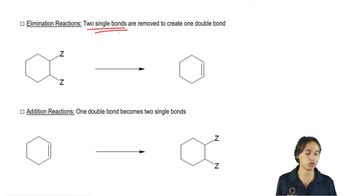
Elimination Reactions

Elimination reactions involve the removal of a small molecule, typically water or hydrogen halide, from a larger molecule, resulting in the formation of a double bond. The two main types are E1 and E2. E1 is a two-step process similar to SN1, where a carbocation intermediate is formed before the elimination occurs. E2 is a concerted mechanism where the base abstracts a proton while the leaving group departs, often requiring strong bases and specific stereochemistry.
Video consigliato:
00:40
Recognizing Elimination Reactions.

Regioselectivity and Stereoselectivity

Regioselectivity refers to the preference of a chemical reaction to yield one structural isomer over others, while stereoselectivity indicates the preference for one stereoisomer over another. In substitution and elimination reactions, these concepts are crucial for predicting the major products. Factors influencing regio- and stereoselectivity include the structure of the substrate, the nature of the nucleophile or base, and the reaction conditions.
Video consigliato:
05:09
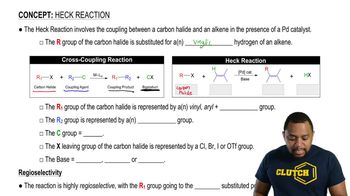
Heck Reaction