Ch. 12 - Substitution and Elimination: Reactions of Haloalkanes
Mullins - Organic Chemistry: A Learner Centered Approach 1st Edition
Mullins1st EditionOrganic Chemistry: A Learner Centered ApproachISBN: 9780137566471Non è quello che usi tu?Cambia libro di testo
Capitolo 11, Problema 7a

In the following reactions, identify the bonds formed and the bonds broken.
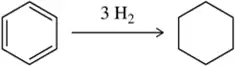
(a) Chemical reaction diagram showing benzene converting to cyclohexane with three hydrogen molecules.

Guida verificata passo dopo passo
1
Step 1: Analyze the reactants and products. The reactant is benzene (C6H6), which contains a six-membered ring with alternating double bonds (aromatic structure). The product is cyclohexane (C6H12), which is a six-membered ring with only single bonds.
Step 2: Identify the bonds broken. In the reaction, the three π-bonds (double bonds) in the benzene ring are broken. These π-bonds are part of the aromatic system.
Step 3: Identify the bonds formed. For each π-bond broken, two new σ-bonds are formed between the carbon atoms and hydrogen atoms. Since 3 H2 molecules are added, a total of 6 C-H σ-bonds are formed.
Step 4: Recognize the type of reaction. This is a hydrogenation reaction, where hydrogen gas (H2) is added to an unsaturated compound (benzene) to convert it into a saturated compound (cyclohexane).
Step 5: Summarize the bond changes. Three π-bonds in benzene are broken, and six C-H σ-bonds are formed, resulting in the conversion of benzene to cyclohexane.

Risposta video verificata per un problema simile:

Questa soluzione video è stata consigliata dai nostri tutor come utile per risolvere questo problema.

Concetti chiave

Ecco i concetti essenziali che devi comprendere per rispondere correttamente alla domanda.

Hydrogenation

Hydrogenation is a chemical reaction that involves the addition of hydrogen (H2) to an unsaturated compound, such as alkenes or alkynes, converting them into saturated compounds. In the context of the provided reaction, benzene (an aromatic compound) undergoes hydrogenation to form cyclohexane, a saturated cyclic alkane. This process typically requires a catalyst, such as palladium or platinum, to facilitate the reaction.
Video consigliato:
00:48
The definition of hydrogenation.

Bonds Broken and Formed

In chemical reactions, bonds are both broken and formed. In the hydrogenation of benzene, the π bonds in the benzene ring are broken, allowing for the addition of hydrogen atoms. Simultaneously, new σ bonds are formed between the carbon atoms of the ring and the hydrogen atoms, resulting in the formation of cyclohexane. Understanding which bonds are broken and formed is crucial for predicting the products of a reaction.
Video consigliato:
06:00
Single bonds, double bonds, and triple bonds.

Aromaticity

Aromaticity refers to the special stability and unique properties of certain cyclic compounds, such as benzene, due to their delocalized π electrons. Aromatic compounds follow Huckel's rule, which states that a compound is aromatic if it has (4n + 2) π electrons, where n is a non-negative integer. In the reaction shown, the loss of aromaticity occurs as benzene is converted to cyclohexane, which is non-aromatic and saturated.
Video consigliato:
08:19
Intro to Aromaticity